
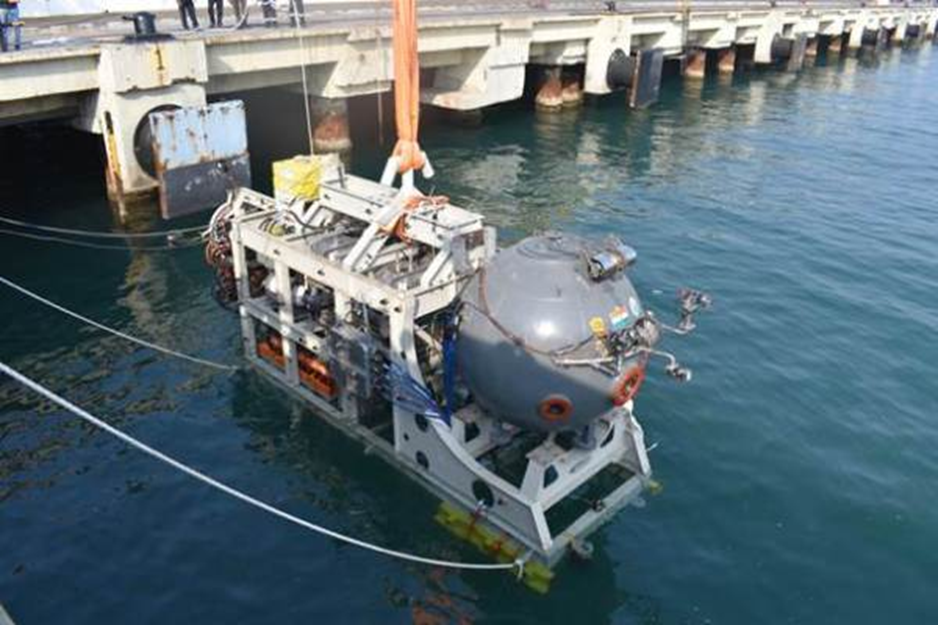
The timeline for the critical 500-metre test dive of Samudrayaan (India’s first manned ocean mission) has been pushed due to delays in procuring Syntactic Foam from France.
1. What is Mission Samudrayaan?
- Objective: To send three humans to a depth of 6,000 metres in the central Indian Ocean.
- Purpose:
- Exploration of deep-sea resources (Polymetallic Nodules/Manganese crusts).
- Biodiversity assessment without disturbing the ecosystem.
- Nodal Ministry: Ministry of Earth Sciences (MoES).
- Implementing Agency: National Institute of Ocean Technology (NIOT), Chennai.
- Global League: Successful completion will make India the 6th country to have a piloted under-sea expedition beyond 5,000 metres (joining the US, Russia, Japan, France, and China).
2. MATSYA 6000 :
- Type: Self-propelled manned submersible.
- Design Capabilities:
- Operational Depth: 6,000 metres.
- Endurance: 12 hours (normal operation) and 96 hours (in case of emergency).
- Construction Material:
- Titanium Hull: The main sphere (for the 6,000m dive) is made of Titanium to withstand immense pressure (approx. 600 bar).
- Partner: The Titanium hulls are manufactured by ISRO.
3 .Why is ‘Syntactic Foam’ Critical?
The current delay is attributed to the procurement of Syntactic Foam from France.
- Function: It provides buoyancy to the submersible.
- Property: Unlike standard hollow floats which can be crushed under deep-sea pressure, syntactic foam is a composite material made of hollow glass or ceramic microspheres filled with resin. It resists compression while maintaining low density, allowing the vehicle to float back up.
4. The Umbrella: Deep Ocean Mission (DOM)
- Nature: Central Sector Scheme (100% funded by the Union Government).
- Budget: ₹4,077 crore (5-year period: 2021-2026).
- Vision: Supports the ‘Blue Economy’ policy.
- Six Pillars of DOM:
- Technologies for Deep Sea Mining & Manned Submersibles.
- Ocean Climate Change Advisory Services.
- Deep-sea Biodiversity exploration.
- Deep Ocean Survey.
- Energy and Freshwater from the Ocean (Offshore Thermal Energy Conversion).
- Advanced Marine Station for Ocean Biology.