Why In the News?
- Recently, the International Monetary Fund (IMF) released its January 2026 update of the World Economic Outlook, titled “Global Economy: Steady amid Divergent Forces,” in which it upgraded the global growth forecast for 2026 to 3.3%.
- This upward revision is primarily attributed to a massive surge in Artificial Intelligence (AI) investments, resilient supply chains, and a faster-than-expected easing of global inflation.
- Key Facts About World Economic Outlook (WEO)
- Released By: The report is a flagship publication of the International Monetary Fund (IMF).
- Frequency: It is published twice a year (usually in April and October), with partial updates released in January and July.
- Purpose: The WEO provides a comprehensive analysis of the global economy, covering near-term and medium-term growth projections, inflation trends, and financial stability.
- Data Source: The projections are based on consultations between IMF staff and member countries (Article IV consultations).
- Major Highlights (January 2026 Update)
- Global Growth Projections: The global economy is expected to grow by 3.3% in 2026 and 3.2% in 2027, showing resilience despite geoeconomic fragmentation.
- Inflation Trends: Global headline inflation is projected to decline from 4.1% in 2025 to 3.8% in 2026, although the pace of disinflation varies across regions.
- AI as a Growth Catalyst: The IMF identifies AI-related investments in data centers and semiconductors as a significant driver that could add up to 0.3 percentage points to medium-term global productivity.
- Risk Factors: Key downside risks identified include geoeconomic confrontation, trade protectionism (tariffs), potential asset bubbles in the tech sector, and geopolitical disruptions in energy-sensitive regions.
- India-Specific Observations
- Fastest Growing Economy: India is projected to remain the world’s fastest-growing major economy, with a growth forecast of 6.4% for both 2026 and 2027.
- Drivers of Growth: Strong domestic demand, robust private consumption, and significant government investment in infrastructure and digitalization are the primary pillars of India’s economic performance.
- Consumer Market: India is on track to become the world’s third-largest consumer market by 2026, supported by a rapidly expanding middle class.
- Other Key Flagship Reports of WEF
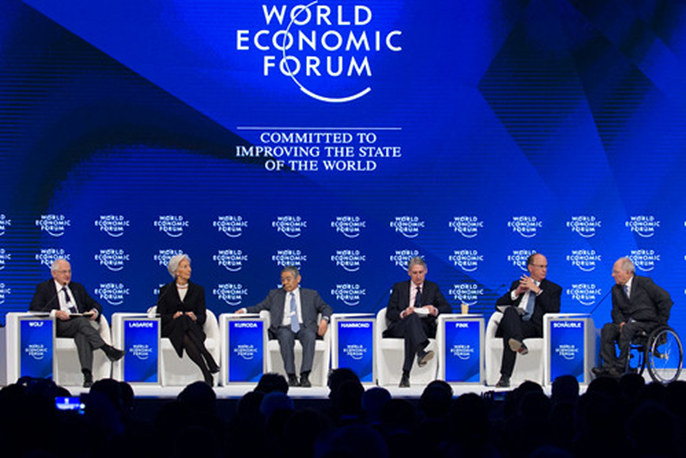
The World Economic Forum is a Swiss non-profit foundation that acts as a platform for public-private cooperation. It publishes several high-impact reports that are essential for the UPSC Prelims.
I. Global Risks Report
- Purpose: It identifies and analyzes the most pressing risks the world faces over two-year and ten-year horizons.
- Key Categories: Economic, Environmental, Geopolitical, Societal, and Technological risks.
- Current Trend: The 2026 report warns of an “age of competition,” where trade protectionism and AI-driven misinformation are top concerns.
II. Global Gender Gap Report
- Dimension of Assessment:
- Economic Participation and Opportunity (India’s weakest area).
- Educational Attainment (India’s strongest area).
- Health and Survival.
- Political Empowerment.
- India’s Status (2025): India is ranked 131st out of 148 countries, showing a slight slip in rank despite a marginal improvement in its parity score.
III. Energy Transition Index (ETI)
- Report Name: Fostering Effective Energy Transition.
- Pillars: System Performance (Equity, Security, Sustainability) and Transition Readiness (Regulation, Infrastructure, Innovation).
- India’s Status (2025): India is ranked 71st, falling from 63rd in 2024, though it received praise for improvements in energy efficiency and investment capacity.
IV. Future of Jobs Report
- Focus: It explores how technology, particularly Generative AI, is reshaping the labor market and identifies the skills most in demand (e.g., analytical thinking, creative thinking, and AI literacy).
V. Other Notable Publications
- Global Competitiveness Report: Assesses the drivers of productivity.
- Travel & Tourism Development Index: Ranks on the attractiveness and sustainable development of the travel sector.
- Global Cybersecurity Outlook: Examines the growing “cyber inequity” between organizations.
Q. Consider the following pairs of Reports and their Publishing Bodies:
1.	Global Risks Report — World Economic Forum (WEF)
2.	Energy Transition Index — International Energy Agency (IEA)
3.	Future of Jobs Report — World Economic Forum (WEF)
4.	Global Competitiveness Report — World Bank

Which of the pairs given above are correctly matched?
(a) 1 and 2 only
(b) 1 and 3 only
(c) 2 and 4 only
(d) 1, 2 and 3 only

Correct Answer: (b)
Solution:
STATEMENT 1 CORRECT: The Global Risks Report is the flagship publication of the WEF, based on the Global Risks Perception Survey.
STATEMENT 2 INCORRECT: The Energy Transition Index (ETI) is published by the World Economic Forum (WEF), not the IEA.
STATEMENT 3 CORRECT: The Future of Jobs Report is an annual/biennial publication by the WEF focusing on labor market transformations.
STATEMENT 4 INCORRECT: The Global Competitiveness Report is a flagship publication of the World Economic Forum (WEF), while the World Bank publishes the (now discontinued) 'Doing Business' report and the 'World Development Report'