
After Reading This Article You Can Solve This UPSC Mains Model Question:
In a “changing world order”, how can India leverage minilateral platforms to secure national interests while maintaining strategic autonomy? (GS-2 International Relations)
Context: Why Diplomatic Strategies Are Changing
The global order is currently witnessing a transition where traditional “Large Tables” (large multilateral institutions like the UN, WTO, and WHO) are increasingly becoming dysfunctional or paralyzed by “veto-culture” and geopolitical polarization (e.g., US-China rivalry, Russia-Ukraine-NATO tensions).
- Defining White Spaces: These are identified as areas where coordination is required for global problems, yet no single major power holds credible charge.
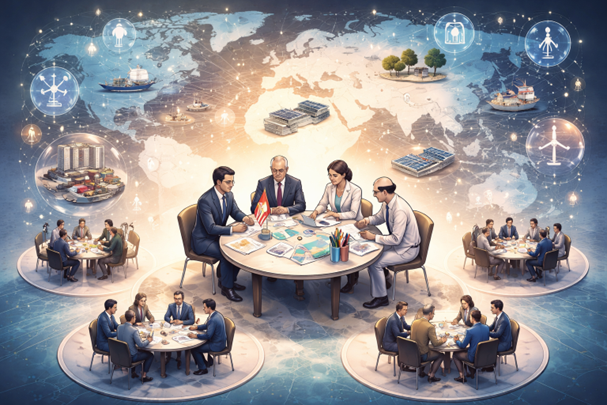
- The Shift: Outcomes are increasingly moving away from large, often paralyzed multilateral bodies like the United Nations toward smaller, functional coalitions—referred to as “small tables”—where tangible dividends can be secured.
About Minilateralism
Minilateralism (or “Small Tables“) is a diplomatic strategy where a small group of nations (usually 3 to 10) collaborate on a narrowly defined, issue-specific agenda rather than seeking broad, universal consensus.
- Distinctive Features of Minilateralism
- Voluntary & Informal: Unlike the UN or WTO, these groups often lack a permanent secretariat or a formal legal charter. They rely on “Soft Law” (MoUs, joint statements, and shared goals) rather than binding treaties.
- Functional Focus: They are “task-oriented” rather than “ideology-oriented.” For example, the SCRI (Supply Chain Resilience Initiative) focuses specifically on trade logistics, not general political alignment.
- Agility & Speed: Because the “table” is small, decision-making is rapid. Akbaruddin notes that while the UN took decades to address certain digital norms, minilateral groups can set standards in months.
- The “Veto-Free” Zone: By excluding countries with fundamentally opposing interests, these groups bypass the “veto paralysis” seen in the UN Security Council.
Why Minilateralism is Rising?
- Institutional Gridlock: Large bodies like the UN Security Council (UNSC) are paralyzed by the Veto power, failing to resolve recent crises (Ukraine, Gaza).
- Reform Stagnation: Developing nations (Global South) feel sidelined as 20th-century institutions (IMF, World Bank) refuse to update their power structures to reflect 21st-century realities.
- Consensus Crisis: Achieving consensus among 193 nations is nearly impossible in a polarized world.
- US-China Rivalry: Strategic competition has broken the “Global Village” concept. Countries now prefer “Small Tables” with like-minded partners to ensure security and technology standards.
- Rise of Middle Powers: Countries like India, UAE, and Japan are no longer bystanders. They are initiating their own groupings (e.g., I2U2) to assert their Strategic Autonomy.
- Agility & Flexibility: Small groups lack bulky bureaucracies. Decisions are made at “the speed of business” rather than “the speed of diplomacy.”
- Issue-Specific Focus: Instead of talking about “Peace” in general, minilaterals focus on tangible goals like:
- Supply Chain Resilience (e.g., SCRI)
- Technology Standards (e.g., 6G or AI)
- Maritime Security (e.g., Quad)
- COVID-19 Lessons: The pandemic proved that while the WHO struggled with global politics, smaller groups (like the Quad Vaccine Partnership) could deliver results faster.
- Climate Urgency: While COP summits struggle with finance, smaller alliances like the International Solar Alliance (ISA) or Global Biofuels Alliance provide actionable, niche solutions.
Major ‘Small Tables’ in India’s Orbit
1. The Security & Geopolitical Tables
- QUAD (India, US, Japan, Australia): The primary vehicle for a “Free and Open Indo-Pacific.” It focuses on maritime domain awareness, space cooperation, and countering non-traditional threats (cyber, climate).
- Net Security Provider: Through initiatives like Maritime Domain Awareness (MDA) and Operation Sagar Bandhu (post-Cyclone Ditwah), India demonstrates its capacity as a first responder.
- India–France–UAE Trilateral: Focuses on the Western Indian Ocean. A key highlight in 2025-26 is the “Rafale Forum”—operationalizing interoperability between the three air forces that all fly Rafale jets.
- India–France–Australia Trilateral: Enhancing maritime security and protecting sea lanes of communication (SLOCs) without being seen as a formal military alliance.
2. The Geo-Economic & Connectivity Tables
- I2U2 (India, Israel, UAE, USA: Known as the “West Asian Quad,” it focuses on six sectors: Water, Energy, Transportation, Space, Health, and Food Security.
- Recent Outcome: UAE’s $2 billion investment in integrated food parks in India using Israeli/US tech.
- IMEC (India–Middle East–Europe Corridor): A multi-modal rail-and-shipping corridor. It serves as a strategic alternative to China’s BRI, linking Indian ports directly to Europe via the Gulf.
3. The Technology & Innovation Tables
- iCET (India-US Initiative on Critical and Emerging Technology): Deep collaboration in AI, semiconductors, and space. It has led to the co-production of GE F414 jet engines in India.
- Mineral Security Partnership (MSP): A 14-nation (plus EU) group ensuring India’s access to Critical Minerals (Lithium, Cobalt) necessary for the green energy transition (including DAC technology).
4. The Global South & Reformist Tables
- BRICS+ (Expanded): While larger now, India uses its 2026 BRICS Presidency as a “small table” within the group to push for “Reformed Multilateralism” and the use of local currencies in trade.
- BIMSTEC (Bay of Bengal Initiative): India’s primary alternative to the paralyzed SAARC, focusing on regional connectivity with South East Asia (Act East Policy).
- Institutional Delivery via NDB: India aims to utilize the New Development Bank (NDB) for tangible public goods—guarantees for green energy and infrastructure—rather than mere declaratory politics.
Why Minilateralism Suit India
1. Preserves Strategic Autonomy: Unlike formal alliances (like NATO), “Small Tables” are issue-based. India can sit with the US in the Quad for security, while simultaneously sitting with Russia and China in BRICS for economic cooperation.
- Freedom of Choice: It allows India to maintain its “Non-West but not Anti-West” identity.
2. Counterbalances Regional Hegemony (China): India alone may face challenges in balancing China’s massive economic/military weight. Joining groups like Quad or the India-France-UAE trilateral allows India to aggregate the power of like-minded partners to ensure a “Free and Open Indo-Pacific.”
- Bypasses Veto Paralysis: At “Large Tables” (UNSC), China can block India’s interests (e.g., terror listings). At “Small Tables,” China is often not present, allowing India to set the agenda.
3. Strategic “Friend-Shoring” & Tech Security: Minilaterals like the iCET (India-US Initiative on Critical and Emerging Technology) or the Mineral Security Partnership provide India access to high-end tech (semiconductors, jet engines) that large multilateral bodies cannot facilitate.
- Supply Chain Resilience: Small groups like the SCRI (Supply Chain Resilience Initiative) help India reduce its import dependence on “hostile” geographies.
4. Cost-Effective Leadership (Global South): Low Friction, High Impact: India doesn’t need to fund a massive UN-style bureaucracy to lead. By initiating “Small Tables” like the International Solar Alliance (ISA) or the Global Biofuels Alliance, India establishes itself as a “Solution Provider” for the Global South at a fraction of the cost.
5.The Venn Diagram of Diplomacy: India thrives in the overlap. It uses different tables for different needs.
- I2U2: For food and energy security.
- IMEC: For physical connectivity to Europe.
- BIMSTEC: For regional stability in the Bay of Bengal.
Challenges of Minilateralism
- “Balkanization” of Global Diplomacy: Proliferation of small groups leads to a fragmented world where there is no “Grand Table” for universal consensus.
- Competing Standards: Different “tables” may create conflicting rules (e.g., US-led vs. China-led digital or trade standards), making global coordination harder.
- “Elitist Clubs”: By nature, “Small Tables” are exclusive. Smaller/weaker nations (Global South) are often left out, leading to a Legitimacy Deficit compared to the UN.
- Voluntary Nature: Most minilaterals rely on “Soft Law” (non-binding MoUs). Without formal treaties or enforcement mechanisms, they can be easily ignored or derailed.
- Forum Shopping: Nations may “shop” for a forum that favors their interests, further weakening established institutions like the WTO or WHO.
- Resource Drain: Diplomatic bandwidth and financial resources are diverted from global institutions to these niche groups, accelerating the decay of the post-WWII order.
- Political Sensitivity: Success often depends on the “chemistry” between specific leaders. A change in government (e.g., elections in US or Japan) can suddenly collapse a minilateral initiative.
- Reinforcement of “Bloc Politics” and Polarization: While designed to solve specific problems, minilaterals often solidify “The West vs. The Rest” dynamics. This fosters global polarization and encourages a return to Cold War-style alliances, increasing the risk of regional and global tensions.
Way Forward
- Multi-Alignment: India must continue to leverage its “Goldilocks” position—sitting at the Quad (with the West) and BRICS/SCO (with Eurasia)—to ensure no single power bloc dictates global norms.
- Strategic Selectivity: Focus resources on minilaterals that provide high tangible dividends (e.g., iCET for Jet Engines, MSP for Critical Minerals) rather than purely symbolic groupings.
- DPI as a Global Standard: India should use its Digital Public Infrastructure (India Stack) as a template for the Global South, setting de facto standards before the UN begins debating them.
- From Informal to Semi-Formal: Gradually build “secretariat-lite” structures for successful groups like I2U2 to ensure project continuity beyond political leadership changes.
- Voice of Global South: Use “Small Tables” as aggregators. For example, India can take the concerns of the 120+ Voice of Global South Summit nations and present them at the G20 or G7 as a “policy arbiter.”
- Hub-and-Spoke Model: Use minilaterals as “test labs” for solutions (like the International Solar Alliance) that can eventually be scaled up to universal multilateral bodies (like UNFCCC).
- Diplomatic Bandwidth: To sit at many tables, India needs more “table-setters.” This requires expanding the Indian Foreign Service (IFS) and engaging more with “Track 1.5″ and “Track 2” (think tanks/academics) to provide technical depth in negotiations.
- Economic Resilience: “Small Tables” are only useful if India is an attractive partner. Success depends on the domestic “Make in India 2.0” and semiconductor missions.
Conclusion:
The 2026 geopolitical landscape demands “Multi-alignment” through “Minilateralism.” For India, the “Small Tables” are not a replacement for the UN, but a necessary pragmatic tool. As Syed Akbaruddin concludes, in a world where the big machinery is jammed, the small gears are what keep the global order moving.