Why in the News?
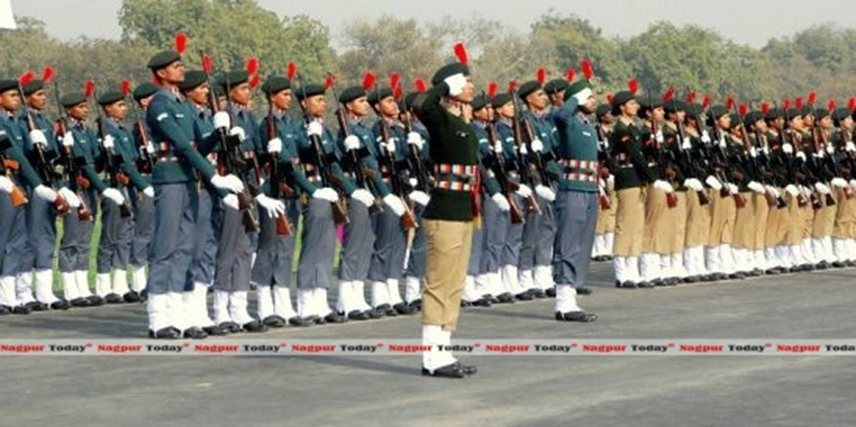
Recently, Vice President Shri C.P. Radhakrishnan formally inaugurated the National Cadet Corps (NCC) Republic Day Camp (RDC) 2026 at Delhi Cantonment, which saw the participation of over 2,400 cadets from all 17 Directorates across India.
During the event, the government highlighted the successful Mount Everest summit by 10 NCC cadets (2025) and the service of 75,000 NCC Warriors in Operation Sindoor for civil defence and disaster relief. It also announced a proposal to expand NCC strength by three lakh cadets to support the vision of Viksit Bharat @2047.
1. Background and Evolution
- Origin: The roots of NCC can be traced back to the University Corps created under the Indian Defence Act, 1917, to compensate for the shortage of personnel in the British Indian Army.
- Establishment: The present-day NCC was formed in independent India on July 15, 1948, under the National Cadet Corps Act, 1948.
- Kunzru Committee: The organization was established based on the recommendations of the H.N. Kunzru Committee (1946), which suggested a national-level cadet organization for schools and colleges.
- Timeline of Expansion:
- 1949: The Girls Division was raised.
- 1950: The Air Wing was added.
- 1952: The Naval Wing was incorporated, making it a truly tri-service organization.
- 1962-1968: NCC training was made compulsory following the Sino-Indian War, but it was reverted to a voluntary status in 1968.
2. Core Institutional Details
- Nature: It is a Tri-Services Organization, comprising the Army, Navy, and Air Force wings. It is the largest uniformed youth volunteer organization in the world.
- Motto: “Unity and Discipline” (Ekta aur Anushasan). This was finalized in 1980.
- Nodal Ministry: It falls under the purview of the Ministry of Defence (MoD).
- Headquarters: Located in New Delhi.
- Leadership: It is headed by a Director General (DG) with the rank of Lieutenant General (three-star military rank).
3. Organizational Structure
- Directorates: There are 17 Directorates located in various state capitals, each headed by an officer of the rank of Major General or equivalent.
- Groups: Directorates are divided into Group Headquarters (headed by Brigadiers).
- Units: Groups control several Units (Battalions), which are the basic functional entities.
- Associate NCC Officers (ANOs): These are school and college teachers who undergo training to lead the cadets at the institutional level.
4. Major Initiatives and Operations
- Puneet Sagar Abhiyan: A nationwide campaign to clean seashores and beaches of plastic and other waste to increase awareness about “Swachh Bharat.”
- Youth Exchange Programme (YEP): An international outreach program where cadets visit friendly foreign countries to promote cultural understanding.
- Operation Sindoor: A notable recent initiative where cadets provided voluntary service for civil defence duties and disaster relief.
Digital Transformation: The Ministry has launched the NCC Integrated Software, an “Entry to Exit” model developed with BISAG, to digitize cadet records and certificates.
Q. With reference to the National Cadet Corps (NCC), consider the following statements:
I.	It was established based on the recommendations of the H.N. Kunzru Committee.
II.	The NCC is administratively controlled by the Ministry of Youth Affairs and Sports.
III.	The organization's motto "Unity and Discipline" was adopted at the time of its inception in 1948.
IV.	Participation in NCC training is currently voluntary for school and college students.

Which of the statements given above are correct?
(a) I and II only
(b) I and IV only
(c) II and III only
(d) I, II, III and IV

CORRECT ANSWER: (B)

Explanation:
STATEMENT I CORRECT: The NCC was indeed formed in 1948 following the recommendations of the H.N. Kunzru Committee.
STATEMENT II INCORRECT: The NCC falls under the Ministry of Defence, not the Ministry of Youth Affairs and Sports.
STATEMENT III INCORRECT: The motto "Unity and Discipline" was formally adopted in 1980, not in 1948.
STATEMENT IV CORRECT: While it was made compulsory briefly after the 1962 war, it has been voluntary since 1968.