
After Reading This Article You Can Solve This UPSC Mains Model Questions:
“The India–EU Free Trade Agreement marks a shift from tariff-led trade to technology-led strategic cooperation.” Discuss its implications for India’s AI and semiconductor ecosystem, with reference to strategic autonomy and economic security. (250 words) (GS-3 Economy)
Context
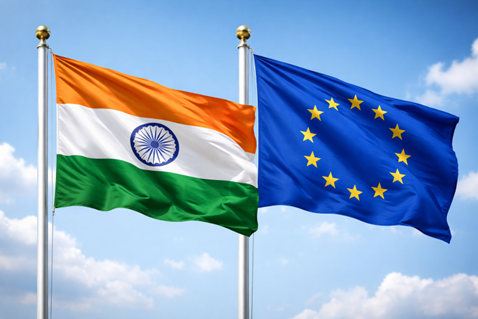
In January 2026, India and the European Union concluded the India–EU Free Trade Agreement (FTA) and simultaneously launched a Comprehensive Strategic Agenda 2030. Unlike conventional FTAs focused on tariffs and market access, this agreement marks a qualitative shift towards deep technology integration, particularly in Artificial Intelligence (AI) and semiconductors, aimed at securing strategic autonomy in critical technologies.
Evolution of India–EU Tech Partnership (Three Phases)
1. Phase I: Diplomatic Engagement (Roadmap to 2025)
- Technology cooperation limited to cybersecurity, 5G, data protection
- Absence of mechanisms for hardware collaboration (chips) or AI model co-development
- Predominantly normative and consultative
2. Phase II: Institutionalization (Trade and Technology Council – 2022)
- Establishment of India–EU Trade and Technology Council (TTC)
- Creation of Working Group on Strategic Technologies
- Entry of technical experts, moving beyond diplomacy to implementation
3. Phase III: Operational & Offensive Partnership (2023 onwards)
- Semiconductor MoU (2023) → initially defensive (supply-chain resilience)
- Current FTA → offensive orientation: joint R&D, design, prototyping, AI-specific chips
- Focus shifts from monitoring shortages to co-creating next-generation technologies
About the India-EU FTA on Semiconductors
1. The Strategy: “Heterogeneous Integration” (HI)
Since India is currently years away from high-end logic fabrication (2-3nm foundries), the pact pivots to the most critical “value-added” segment of the modern supply chain.
- Definition: HI involves stacking diverse chips (logic, memory, sensors) into a single high-performance package.
- Significance: This is the heart of AI Accelerators (like NVIDIA’s GPUs). It is less capital-intensive than a foundry but provides equal performance gains, allowing India to lead in AI hardware without waiting for domestic 2nm fabs.
- Vertical Integration: The focus has shifted from “chips for cars” (2023 priority) to “chips designed for AI models.”
2. The Operational Vehicle: “Blue Valleys”
The deal introduces Blue Valleys, which are regulatory “islands” or exclaves on Indian soil.
- Standard Alignment: These zones align Indian manufacturing standards with European ones (Technical Barriers to Trade).
- Frictionless Export: Products made in Blue Valleys flow directly into the EU Single Market without requiring new certifications, making India a seamless extension of the European supply chain.
3. Merging “Designer Capital” with “Physical Capital”
The pact creates a symbiotic relationship to break the global reliance on US-owned Intellectual Property (IP).
- India’s Contribution: Roughly 20% of global chip design talent.
- EU’s Contribution: Cutting-edge research infrastructure like IMEC (Belgium) and Fraunhofer (Germany).
- Outcome: Joint prototyping of indigenous chips, ensuring “Strategic Autonomy” for both regions.
4. Financial “Force Multipliers”
To solve the problem of risk-averse domestic capital, the deal unlocks two major European funding taps:
- European Innovation Council (EIC): Known for “Patient Capital,” it will now fund “Hard Tech” (Quantum, Novel Chip Architectures) in India through the Start-up India platform.
About the India-EU FTA on AI
1. The “Common Market” for AI
- Regulatory Export: India aligns with the EU AI Act, granting Indian firms “adequacy” status. This removes compliance barriers for exporting AI models to the EU.
- Data-Model Symbiosis: Pairs India’s multilingual datasets with the EU’s high-end compute (e.g., EuroHPC) and research infrastructure.
- Standardization: Incentivizes Indian startups to adopt European standards early, ensuring global compatibility from day one.
2. Institutional Linkage: AI Safety & Auditing
- Direct Hotline: Establishes a technical channel between the European AI Office and IndiaAI Safety Institute, bypassing traditional diplomatic delays (MEA/EAS).
- Mutual Recognition: Works toward reciprocal acceptance of safety certificates between the two regions.
- Joint Testing: Co-authors mathematical tests for hallucinations, bias, and political neutrality to ensure synchronized model clearance.
3. Civil Liberties: The “Backdoor” Protection
- Regulatory Embedding: Domestic products likely inherit EU safety guards by default due to export requirements.
- Protections: Benchmarks aggressively penalize minority bias and restrict invasive biometric surveillance.
- Impact: Ensures Indian users benefit from human-centric AI that is technically constrained from reinforcing majoritarian narratives.
4. Financial & Talent Mobility
- Horizon Europe: Exploratory talks for India to associate with this €95.5 billion fund, allowing Indian researchers to lead global consortia.
- Legal Gateway Office: A new “one-stop hub” in India to facilitate uncapped mobility for Indian AI talent and researchers moving to Europe.
- Startup Partnership: Links the European Innovation Council with Start-up India to provide “patient capital” for high-risk deep-tech AI.




Strategic Significance of the India-EU FTA for India
1. Strategic Autonomy & Diversification
- Hedging Risks: Reduces over-reliance on the US (for technology) and China (for supply chains).
- Multipolar Pole: Positions India and the EU as democratic counterweights to China’s state-led trade model and the unpredictability of US trade policies.
2. “Make in India” 2.0
- China Plus One: The deal officially integrates India into European Value Chains.
- Standard Setting: Through the “Brussels Effect,” India gets a seat at the table to co-write global standards for AI safety and Green Tech.
3. Economic Security & Market Access
- Preferential Entry: Grants duty-free access to 99% of Indian exports (textiles, pharma, engineering), critical after the 2025 suspension of GSP (Generalized System of Preferences) benefits.
- Energy Transition: The Green Hydrogen Task Force and CBAM flexibilities (Carbon Border Adjustment Mechanism) allow Indian industry to de-carbonize without losing export competitiveness.
4. Talent Mobility (Brain Gain)
- The Mobility Framework: This is the first-ever EU-level mobility pact. It ensures “uncapped” movement for Indian AI and semiconductor professionals, turning “brain drain” into a structured “brain circulation” with Social Security protections.
Key Challenges in the India–EU AI–Semiconductor Partnership
- Regulatory Compliance Burden (The “Brussels Effect”): Indian startups may face high costs and technical hurdles to align with the EU AI Act’s rigid risk-based classifications.
- Carbon-Linked Non-Tariff Barriers (CBAM): The Carbon Border Adjustment Mechanism (CBAM) could impose heavy taxes on Indian semiconductor components if they aren’t manufactured using 100% certified “green” energy.
- Data Sovereignty and Adequacy Gaps: Divergences between India’s DPDP Act (Digital Personal Data Protection) Act (2023) and the EU’s GDPR (General Data Protection Regulation) create legal friction for the “Common Market,” as India lacks official “Data Adequacy” status.
- Infrastructure and Capital Intensity: While the deal focuses on “Design,” India still faces a deficit in the massive physical capital and ultra-pure utilities (water/power) required for actual Semiconductor Fabrication.
- Risk of Talent Poaching (Brain Drain): The “Legal Gateway Office” intended for mobility might inadvertently facilitate a one-way flow of India’s 20% global chip design talent to higher-paying European hubs.
- Implementation of “Blue Valleys”: Establishing these regulatory exclaves requires complex state-level reforms in India to match European standards, risking delays in operationalizing the supply chain.
Way Forward
- Regulatory Convergence (The “Adequacy” Push): Achieving “Data Adequacy” status by aligning the DPDP Act with GDPR is vital for frictionless cross-border AI training and digital trade.
- Neutralizing “Green Protectionism”: Establishing a CBAM Dialogue to recognize India’s carbon-credit schemes ensures technical aid for MSMEs, preventing green taxes from becoming trade barriers.
- Operationalizing “Blue Valleys”: Accelerating state-level reforms provides the “plug-and-play” infrastructure needed to integrate Indian semiconductor exclaves into European Tier-1 supply chains.
- Securing “Patient Capital”: Linking the European Innovation Council with Start-up India unlocks long-term funding for high-risk “Hard Tech” like Quantum and HI chips.
- Institutionalizing Talent Mobility: Utilizing the Legal Gateway Office promotes “Brain Circulation,” ensuring returning professionals are integrated into domestic R&D through joint doctoral and research programs.
- Expanding Strategic Connectivity: Integrating the IMEC corridor with the FTA’s digital goals creates a “digital corridor” for secure, high-speed data flow and component logistics.
Conclusion
The India-EU FTA transcends traditional trade, cementing a technological-security alliance that secures India’s strategic autonomy. By merging India’s design talent with Europe’s research infrastructure, the pact establishes a democratic counterweight in AI and semiconductors. Success now hinges on navigating CBAM regulations and regulatory alignment to transform this roadmap into a resilient, human-centric digital future.