
After Reading This Article You Can Solve This UPSC Mains Model Question:
“The liberal, rules-based globalisation order is giving way to a mercantilist world driven by power politics and trade coercion.” Examine the implications of this shift for developing countries, particularly India. (GS-1, Society)
Context
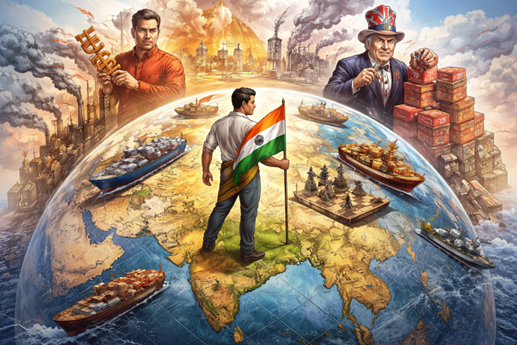
Recent remarks by U.S. President Donald Trump linking tariffs and India’s Russian oil imports underline a deeper systemic shift in the global political economy. The issue is not episodic trade coercion, but the collapse of the liberal, rules-based globalisation model and the re-emergence of mercantilism, where trade is increasingly used as an instrument of state power.
Globalisation: Beyond Free Trade
- Globalisation was not merely economic integration but a political system governing markets, societies, and inter-state relations.
- It was embedded in liberal ideas: open markets, multilateralism, democracy, and global cooperation.
- Institutions like WTO, IMF, World Bank provided a normative framework that restrained unilateral power.
- This legitimacy has now eroded; open disregard for rules signals the end of that system.
Evolution of Globalisation
1. Archaic & Proto-Globalization (Pre-1800s): Trade by Force
- Mercantilism (16th–18th Century): The dominant theory was that the world’s wealth was static (measured in gold/silver). Nations like Britain, France, and Spain used “Force-based Trade” to extract resources.
- Colonial Extraction: This era was defined by Zero-Sum logic: one nation’s gain was another’s loss.
2. Globalization 1.0 & 2.0 (1800s–1945): Industrial Imperialism
- The Steam Age: Inventions like the steam engine and telegraph lowered trade costs.
- The Collapse: This phase ended with the World Wars and the Great Depression (1929), which saw a massive retreat into Protectionism and economic nationalism.
3. Globalization 3.0 (1945–2008): The Liberal Order
- Institutional Framework: Post-WWII, the Bretton Woods System (IMF, World Bank) and GATT (later WTO in 1995) were created to prevent a return to mercantilism.
- Rules-Based Order: For the first time, trade was governed by shared norms:
- Most Favoured Nation (MFN): Treating all trading partners equally.
- National Treatment: Treating foreign goods the same as local ones.
- The Golden Age: This era saw unprecedented poverty reduction but led to the “Unintended Consequences” mentioned in the text: rising inequality and the surge of China.
4. Globalization 4.0 & Neo-Mercantilism (2008–Present)
- The Great Pivot: The 2008 financial crisis exposed the flaws of hyper-globalization. By 2026, we have entered Neo-mercantilism, where:
- Security > Efficiency: Supply chain resilience and “de-risking” (reducing dependency on rivals like China) are more important than low costs.
- Politicization of Trade: Leaders like Donald Trump use tariffs as “diplomatic leverage,” effectively dismantling the 80-year-old rules-based system.
Reason for the End of Globalisation
- Zero-Sum Logic: Trade is no longer viewed as a “win-win” collaboration (comparative advantage). Instead, it has returned to Mercantilism, where surpluses are seen as strength and deficits as strategic weaknesses.
- Weaponization of Trade: U.S. President Trump’s 2025-26 policy treats tariffs as leverage to compel foreign capitals to follow U.S. interests.
- The “China Model” Failure: China subverted the “trade leads to democracy” theory by leveraging global markets to accumulate power while maintaining authoritarian state control, proving wealth can exist outside the liberal order.
- Decoupling & De-risking: Fears of over-dependence on rivals have led to “friend-shoring” or “near-shoring,” where supply chains are restricted to political allies rather than the lowest-cost producer.
- Wages vs. Capital: Globalization facilitated the rapid movement of capital but not people. This led to a stark imbalance where returns to capital (profits) far outstripped increases in wages, fueling massive inequality.
- Dysfunctional WTO: Global institutions established to manage trade (like the WTO) have lost their normative power. Without a functioning dispute settlement mechanism, nations resort to unilateral actions, making global cooperation an “opportunity cost.”
- State Interventionism: By 2026, the era of laissez-faire (free markets) has given way to heavy state intervention through subsidies and industrial policy to buy self-sufficiency.
Impact on Developing Countries
- Weakened multilateral support: Conditional aid and declining effectiveness of WTO/IMF limit policy space (e.g., stalled WTO dispute settlement hurting India’s trade remedies).
- Reduced collective bargaining power: Fragmentation undermines joint action on climate finance and illicit financial flows, affecting India’s climate adaptation funding.
- Trade coercion & tariffs: U.S. tariff threats linked to India’s energy and strategic choices, hit labor-intensive sectors like textiles, gems, and jewelry the hardest, threatening millions of MSME jobs.
- Industrial crowding-out: China’s excess-capacity exports suppress manufacturing in poorer economies, constraining India’s Make in India ambitions.
- Supply-chain volatility: Red Sea disruptions and sanctions raise logistics costs for India’s Suez-route trade.
- Fiscal & social stress: Youth unemployment and inequality intensify demands on the state; limited fiscal space restricts India’s health and education spending.
- Regionalism: For India, the IMEC and BIMSTEC are no longer just “options” but essential survival lifelines in a world of “zero-sum” trade.
India’s Position at the End of Globalisation
1. The “Too Large to Ignore, Too Poor to Lead” Dilemma
- Scale vs. Stature: Despite a $4+ trillion economy and 1.45 billion people, India’s global influence is constrained by low per-capita income and underinvestment in health and education prevent it from setting the global agenda.
- Demographic Drag: India has largely missed the window to fully convert its youth bulge into a manufacturing powerhouse. The social pyramid is sharply stratified, with a narrow high-income apex and a vast, economically vulnerable base.
2. Strategic “Safe Harbors” & Domains of Excellence
- Digital Public Infrastructure (DPI): The global export of the “India Stack” (UPI, Aadhaar) offers a sovereign digital alternative for the Global South, independent of Big Tech or Chinese state control.
- Renewable Energy Leadership: Through the International Solar Alliance and the National Green Hydrogen Mission, India is positioning itself as a “Green Energy Hub,” crucial for the global climate transition.
- Strategic Autonomy 2.0: India maintains a unique “multi-aligned” stance—hosting the Arab League, managing a transactional U.S. relationship, and reviving the IMEC corridor to ensure connectivity.
3. Vulnerabilities in a Mercantilist World
- Low State Capacity: In a world where the “State” is the primary economic driver, India’s bureaucratic hurdles and low R&D spending (<1% of GDP) result in a “state capability gap” compared to China or the U.S.
- The Tariff Shock: As seen in early 2026, India remains vulnerable to unilateral U.S. tariffs. Without a broader manufacturing base, India struggles to retaliate effectively or find immediate alternative markets for its MSME exports.
Way Forward
1. Economic Sovereignty: “Disciplined Swadeshi”
- The Three-Tier Defense: Instead of blanket protectionism, the Economic Survey 2026 proposes a calibrated approach:
- Tier 1: High-urgency indigenization for critical strategic vulnerabilities (e.g., semiconductors, active pharmaceutical ingredients).
- Tier 2: Building economically feasible, high-payoff domestic capabilities.
- Tier 3: Strengthening advanced manufacturing to make India a “must-have” partner in global supply chains.
- De-risking, not Decoupling: Selectively lowering barriers for intermediate goods that bolster domestic production while tightening “factory gates”.
2. Re-imagining State Capacity
- Bureaucratic Risk-Taking: Moving away from a “culture of scrutiny” to an “entrepreneurial regime”, similar to the models used in Japan and South Korea, to speed up mission-mode projects like Green Hydrogen.
- Trust-Based Compliance: Transitioning from “inspection-based control” to “trust-based compliance” through automated monitoring and a unified Digital State Stack to reduce the “compliance tax” on MSMEs.
3. Trade Diversification & “Safe Harbors”
- The “Mother of All Deals”: Leveraging the newly concluded India-EU FTA (Jan 2026) to offset the 50% U.S. tariff shock.
- Minilateralism: Prioritizing smaller, agile groupings like IMEC and I2U2 over dysfunctional large multilateral bodies.
- Rupee Internationalization: Rapidly scaling local currency settlement systems (Rupee-Riyal, Rupee-Dirham) to reduce exposure to the “politicized finance” of the U.S. dollar.
4. Human Capital: The Final Frontier
- From Volume to Value: Shifting the focus from “labor-intensive” to “high-productivity” manufacturing. This requires urgent state-level reforms in land acquisition and deep investments in skill-mapping to fix the mismatch between current graduate skills and high-tech industry needs.
- Social Cohesion: Strengthening the internal social contract through sustained public investment in health and education to ensure that growth is not just concentrated at the “apex” of the pyramid.
Conclusion
In a neo-mercantilist 2026, India’s relevance hinges on transforming from a “passive market” to a “strategic provider.” By leveraging Digital Public Infrastructure and Green Hydrogen as global public goods, India can lead the Global South, bridging the gap between nationalist protectionism and the need for resilient, high-tech global connectivity.