
After Reading This Article You Can Solve This UPSC Mains Model Questions:
“In the context of evolving geopolitical dynamics in West Asia, examine the significance of the India–Arab League partnership for India’s strategic, economic, and energy interests. What are the key challenges, and how should India navigate them?” (GS-2, International Relations)
Context
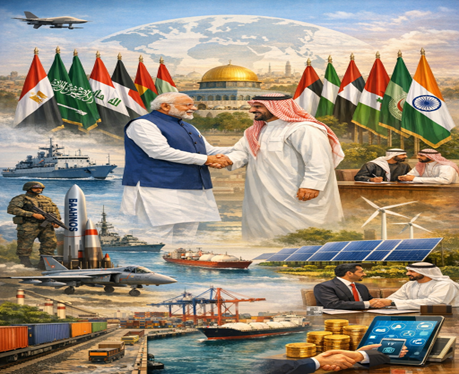
The 2nd India–Arab Foreign Ministers’ Meeting (IAFMM) marks a significant diplomatic outreach amid regional conflicts in West Asia, shifts in the global order, and evolving power dynamics within the Arab world. The meeting reflects India’s growing strategic, economic, and security engagement with the Arab League (League of Arab States – LAS).
About Arab League
- Official name: League of Arab States (LAS)
- Established: 22 March 1945, Cairo
- Original Members: Egypt, Iraq, Transjordan (now Jordan), Lebanon, Saudi Arabia, Syria, and Yemen.
- Members: 22 countries across North Africa and West Asia
- Objective: Political coordination, economic cooperation, and safeguarding sovereignty of Arab states
Evolution of India–Arab League Relations
1. The Nehruvian Era (1947–1964): Ideological Solidarity
- Decolonization & NAM: India, under Nehru, shared a strong bond with Arab leaders like Egypt’s Gamal Abdel Nasser. The relationship was built on anti-colonialism and the Non-Aligned Movement (NAM).
- Palestine Policy: India was the first non-Arab state to recognize the PLO (1974) and consistently supported the Palestinian cause, which acted as a unifying factor for the Arab League.
- Suez Crisis (1956): India’s staunch support for Egypt during the Suez Crisis solidified its “pro-Arab” image.
2. The Middle Phase (1970s–1990s): Energy & Diaspora
- Oil Dependency: Following the 1973 oil shock, India’s focus shifted toward securing energy supplies from the Gulf.
- Labor Export: The 1970s oil boom led to a massive influx of Indian expatriates to the Gulf, making remittances a vital part of India’s economy.
- Transactional Ties: Relations were largely “buyer-seller” in nature, focused on crude oil and labor exports.
3. The Institutionalization Phase (2002–2014)
- MoU of 2002: India and LAS signed a landmark MoU in Cairo to institutionalize political dialogue.
- Strategic Expansion: India was granted Observer Status in the Arab League in 2007—a significant diplomatic nod to its regional importance.
- Arab-India Cooperation Forum (AICF): Established in 2008 to expand cooperation into investment, culture, and science.
4. The “Act West” Era (2014–Present): Strategic Convergence
- Beyond Oil: Policy shifted from passive “Look West” to proactive “Act West.” The focus moved to counter-terrorism, maritime security, and defense manufacturing.
- Strategic De-hyphenation: India successfully balanced its deepening ties with Israel while simultaneously elevating relations with the Arab world to “Comprehensive Strategic Partnerships.”
- Minilateralism: Inclusion in groups like I2U2 (India, Israel, UAE, USA) and the launch of the IMEC (2023) show India’s role as a regional integration pillar.
- 2026 Milestone: The 2nd India-Arab Foreign Ministers’ Meeting in Delhi (Jan 30-31, 2026) signifies India’s transition from a trade partner to a security provider and investment destination.
Present Geopolitical Situation in West Asia
- Uncertainty in Iran, Syria, and Gaza peace process
- U.S.-Iran Confrontation: The USS Abraham Lincoln and a massive fleet (larger than the 2025 Venezuela deployment) have entered the Persian Gulf.
- Military Confrontation: Recently Saudi-backed forces reportedly displaced the UAE-backed Southern Transitional Council (STC) from Aden.
- Rival Blocs: Saudi Arabia is pivoting toward a “Regional Order” involving Turkey and Pakistan, while the UAE leans into its strategic alignment with Israel and the U.S.
- India’s balancing strategy: India is hosting the 2nd IAFMM to act as a “stable anchor” amidst the Saudi-UAE rift while reviving the IMEC and massive energy deals to insulate itself from U.S.-Iran tensions.
Key Pillars of India–Arab League Relations
1. Strategic & Political Cooperation
- Strategic Partnership Agreements with: Oman (2008), UAE (2015), Saudi Arabia (2019), Egypt (2023), Qatar (2025)
- Convergence of long-term national visions: Saudi Vision 2030, UAE Centennial 2071, Oman Vision 2040, Kuwait Vision 2035
- India is recognized as one of Saudi Arabia’s 8 strategic partners
2. Trade, Investment & Connectivity
- Bilateral trade: Over $240 billion
- Critical Sea Lanes: Suez Canal, Red Sea, Gulf of Aden
- CEPA agreements: UAE and Oman
- India–UAE trade target: $200 billion by 2030
- Major investment commitments:
- UAE: $75 billion
- Saudi Arabia: $100 billion
- Qatar: $10 billion
- FDI inflows from region: Over $2.5 billion (infrastructure-focused)
- India–Middle East–Europe Economic Corridor (IMEC):
- Announced at G20 New Delhi Summit, 2023
- Aimed at integrating ship-to-rail transit networks to bypass traditional maritime chokepoints.
3. Digital & FinTech Cooperation
- RuPay card launched in UAE (2019)
- Currency Settlement: Operationalization of the Rupee-Dirham (and recently Rupee-Riyal) settlement systems to reduce dollar dependency.
- Rupee–Dirham settlement mechanism operational
- UPI acceptance: UAE, Saudi Arabia, Qatar, Bahrain
- Significance: financial inclusion, faster remittances, digital diplomacy
4. Energy Security
- Region supplies:
- ~60% of India’s crude oil
- ~70% of natural gas
- 50% of fertilizers
- Major crude exporters: Iraq, Saudi Arabia, UAE
- Strategic Petroleum Reserves:
- UAE investment: $400 million (oil storage in India)
- LNG Agreements:
- Qatar: $78 billion deal (7.5 MTPA LNG for 20 years, signed 2024)
- ADNOC–Indian Oil: 1.2 MTPA LNG for 14 years (2023)
5. Defence & Security Cooperation
- Defence agreements with Oman, UAE, Saudi Arabia, Egypt, Qatar
- Focus areas: Counter-terrorism, Maritime security, Joint military exercises
- SAGAR doctrine: Security and Growth for All in the Region
- Duqm Port Agreement (Oman):
- Logistical access for Indian Navy
- Strategic oversight of PLA Navy activities
- Strong Arab support to India against terrorism:
- Condemnation of Uri, Pathankot, Pulwama, Pahalgam attacks
6. Diaspora & Cultural Diplomacy
- Human Capital: Over 9 million Indians reside in LAS nations, contributing significant remittances and acting as a living bridge of “soft power.”
- Institutional Support: Initiatives like the ‘House of India’ in Abu Dhabi and the India-Arab Universities’ Presidents’ Conference strengthens academic and cultural ties.
Challenges of India–Arab League Relations
- Regional instability and conflicts: Ongoing crises in Gaza, Syria, Yemen, and tensions around Iran disrupt economic activity and complicate diplomatic engagement.
- Intra-Arab divisions: Divergence between Saudi Arabia and the UAE over Yemen and regional influence weakens unified Arab positions.
- Great power rivalry: Intense U.S.–China competition in West Asia forces India to balance ties (e.g., U.S. pressure on India regarding Iran and Chabahar port).
- Energy transition uncertainties: Global shift towards renewables may reduce long-term oil demand, affecting ties with hydrocarbon-dependent partners like Saudi Arabia and Iraq.
- Maritime security threats: Attacks and disruptions in the Red Sea and Gulf of Aden raise shipping costs for Indian trade passing through the Suez route.
- Political sensitivities on Israel–Palestine: India’s deepening ties with Israel alongside strong support for Palestine require careful diplomatic calibration with Arab states.
- Security spillovers: Terrorism, cyber threats, and drone warfare in the region pose risks to Indian diaspora and assets.
Way Forward for India–Arab League Relations
- Institutionalise strategic dialogue through regular ministerial and security-level consultations with LAS.
- Promote stability and de-escalation by supporting dialogue on Gaza, Iran, and Yemen while maintaining strategic autonomy.
- Operationalise IMEC to strengthen connectivity, supply chains, and regional interdependence.
- Expand energy cooperation to include renewables, green hydrogen, and strategic petroleum reserves.
- Strengthen maritime security collaboration under SAGAR in the Red Sea and Indian Ocean Region.
- Scale up defence co-production and exports under ‘Make in India’ in defence.
- Leverage digital public infrastructure (UPI, RuPay, fintech) for financial integration and people-to-people ties.
Conclusion
The India-Arab partnership is transitioning from a traditional energy-buyer relationship into a high-tech strategic alliance. The integration of IMEC, Digital Public Infrastructure, and Green Hydrogen will position India as a “Stable Anchor” in West Asia, balancing regional rifts while securing a resilient, multipolar global order.