
After Reading This Article You Can Solve This UPSC Mains Model Question:
The Union Budget 2026–27 reflects a calibrated approach towards growth, inclusion, and fiscal consolidation.” Critically examine this statement in the context of India’s goal of achieving Viksit Bharat 2047. 250 words (GS-3, Economy).
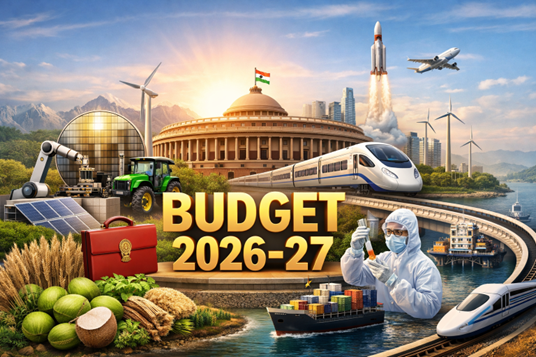
CONTEXT
The Union Budget 2026–27, presented by Nirmala Sitharaman, is the first Budget prepared in Kartavya Bhawan, symbolising a shift from entitlement-based governance to duty-driven (“Kartavya”) development.
It is framed around three Kartavyas, aiming to balance growth, inclusion, and resilience amid global economic volatility, supply-chain realignments, and India’s aspiration of Viksit Bharat @2047.
Macroeconomic Snapshot
- Total Expenditure (BE 2026–27): ₹53.5 lakh crore
- Non-debt Receipts: ₹36.5 lakh crore
- Net Tax Receipts: ₹28.7 lakh crore
- Capital Expenditure: ~₹12.2 lakh crore (growth-oriented stance)
- Fiscal Deficit: 4.3% of GDP (glide path consolidation)
- Debt–GDP Ratio: 55.6% (improving sustainability)
Philosophy & Framework of the Budget
The Budget is anchored in three Kartavyas, reflecting a transition from entitlement-based to responsibility-based public policy.
1️. First Kartavya – Accelerate & Sustain Economic Growth
- Enhance productivity and competitiveness
- Build resilience against volatile global economic conditions
2. Second Kartavya – Fulfil Aspirations & Build Human Capacity
- Empower citizens as partners in India’s growth
- Focus on skills, employability, and services-led growth
3. Third Kartavya – Sabka Sath, Sabka Vikas
- Ensure equitable access to resources and opportunities
- Focus on regions, communities, and vulnerable sections
1. FIRST KARTAVYA: ACCELERATE & SUSTAIN ECONOMIC GROWTH
I. Manufacturing Push in Strategic & Frontier Sectors
(a) Biopharma SHAKTI (Strategy for Healthcare Advancement through Knowledge, Technology and Innovation)
- ₹10,000 crore (5 years) to position India as a global biopharma hub
- New & upgraded National Institutes of Pharmaceutical Education and Research (NIPER), 1,000+ clinical trial sites
Significance: Moves India up the pharma value chain
(b) India Semiconductor Mission (ISM) 2.0
- Focus on equipment, materials, full-stack IP, and industry-led R&D
- Reduces import dependence, strengthens strategic autonomy
(c) Electronics Components Manufacturing
- Outlay enhanced to ₹40,000 crore
- Complements PLI ecosystem
(d) Rare Earth Corridors
- Odisha, Kerala, Andhra Pradesh, Tamil Nadu
(e) Chemical Parks & Capital Goods
- 3 Chemical Parks (challenge mode)
- Hi-Tech Tool Rooms, CIE Scheme, Container Manufacturing (₹10,000 crore)
II. Integrated Programme for Textile Sector
- National Fibre Scheme:
Natural fibres (silk, wool, jute), man-made & new-age fibres - Textile Expansion & Employment Scheme:
Cluster modernisation, machinery, testing & certification - Mega Textile Parks:
Focus on technical textiles, value addition - Mahatma Gandhi Gram Swaraj Initiative:
Khadi, handloom & handicrafts + branding & global linkage
III. Rejuvenation of Legacy Industrial Clusters
- 200 clusters to be revived via infrastructure & technology upgrade
IV. Champion SMEs & Micro Enterprises
- ₹10,000 crore SME Growth Fund to create future Champions, incentivizing enterprises based onselect criteria
- Additional ₹2,000 crore to Self-Reliant India Fund to continue support to micro enterprises and maintain their access to risk capital.
- Corporate Mitras via ICAI/ICSI/ICMAI to design short-term, modular courses and practical tools.
V. Infrastructure as Growth Engine
- Public Capex: ₹12.2 lakh crore
- Infrastructure Risk Guarantee Fund (crowding-in private investment)
- New Dedicated Freight Corridor (Dankuni–Surat)
- 20 National Waterways (5 years)
- Start: NW-5 (Odisha – Talcher/Angul to Paradeep/Dhamra)
- Ship repair hubs: Varanasi & Patna
- Coastal Cargo Promotion Scheme- Modal share: 6% → 12% by 2047
- Seaplane VGF Scheme (connectivity + tourism)
VI. Energy Security & Climate Action
- ₹20,000 crore for Carbon Capture Utilisation & Storage (CCUS)
VII. City Economic Regions (CERs)
- ₹5,000 crore per CER (5 years)
- 7 High-Speed Rail Corridors as growth connectors
- Municipal Bonds: ₹100 crore incentive for issuances >₹1000 crore
2. SECOND KARTAVYA: ASPIRATIONS & HUMAN CAPITAL
I. Services-Led Growth
- High-Powered Education-to-Employment & Enterprise Committee recommends measures that focus on the ServicesSector as a core driver of Viksit Bharat.
II. Health & Human Resources
- 100,000 Allied Health Professionals to be added over the next 5 years.
- 5 Regional Medical Hubs (medical tourism)
- 3 new All India Institutes of Ayurveda
- 1 girls’ hostel to be established in every district
III. Orange Economy (AVGC)
- Visual Effects, Gaming and Comics (AVGC) labs in 15,000 schools & 500 colleges, Support via Indian Institute of Creative Technologies, Mumbai
IV. Tourism, Culture & Sports
- National Institute of Hospitality
- 10,000 trained tourist guides in 20 tourist sites
- National Destination Digital Knowledge Grid to digitally document all places of significance—cultural, spiritual andheritage.
- 15 iconic heritage sites (Lothal, Dholavira, Rakhigarhi, Adichanallur, Sarnath, Hastinapur, and Leh Palace etc.) to be developed into vibrant, experiential cultural destinations
- Khelo India Mission (decade-long vision)
3. THIRD KARTAVYA: SABKA SATH, SABKA VIKAS
I. Increasing Farmer Incomes (Centred on water security, crop diversification, and digital enablement).
- Integrated development of 500 reservoirs & Amrit Sarovars to reinforce irrigation capacity, ensure reliable water availability, and strengthen rural livelihoods.
- High-value crops: coconut, sandalwood, cocoa, cashew
- Coconut Promotion Scheme
- Bharat-VISTAAR: (Virtually Integrated System to Access Agricultural Resources)— a multilingual, AI-enabled platform that integrates AgriStack portals with ICAR’s agricultural practice packages,
II. Empowering Divyangjan
- Divyangjan Kaushal Yojana (IT, AVGC, hospitality)
III. Mental Health & Trauma Care
- NIMHANS-2 in North India
- Upgrade Ranchi & Tezpur institutes as regional apex bodies.
IV. Purvodaya & North-East Focus
- East Coast Industrial Corridor (node at Durgapur)
- 5 tourism destinations in Purvodaya States
- 4,000 e-buses
- Development of Buddhist Circuits in Arunachal Pradesh, Sikkim, Assam, Manipur, Mizoram and Tripura.
Fiscal Federalism: Government provided ₹1.4 lakh crore to the States for the FY 2026-27 as Finance Commission Grants as recommended by the 16th Finance Commission.
Critical Analysis of Union Budget 2026–27
Strengths of Union Budget 2026–27
- Strong growth push with fiscal prudence: Public capital expenditure raised to ₹12.2 lakh crore, while fiscal deficit reduced to 4.3% of GDP (from 4.4% in 2025–26).
- Manufacturing and self-reliance focus: Major allocations such as ₹40,000 crore for electronics components, ₹10,000 crore for Biopharma SHAKTI, and ₹10,000+ crore for container manufacturing strengthen industrial depth.
- Infrastructure-led multiplier effect: Total expenditure at ₹53.5 lakh crore, with large investments in freight corridors, waterways (20 NWs), and high-speed rail to boost logistics efficiency.
- Support to MSMEs and entrepreneurship: ₹10,000 crore SME Growth Fund and ₹2,000 crore additional support to the Self-Reliant India Fund improve access to risk capital.
- Energy and sustainability orientation: ₹20,000 crore committed over five years for Carbon Capture, Utilisation and Storage (CCUS), aligning growth with climate goals.
- Human capital and services emphasis: Creation of 100,000 Allied Health Professionals, AVGC labs in 15,000 schools and 500 colleges, and tourism skill initiatives strengthen employment potential.
- Balanced regional and social inclusion: Targeted spending on Purvodaya & North-East, agriculture (500 reservoirs, Amrit Sarovars), and ₹1.4 lakh crore Finance Commission grants to States.
Concerns of Union Budget 2026–27
- High borrowing requirement: Gross market borrowing at ₹17.2 lakh crore keeps pressure on interest rates and private investment (crowding-out risk).
- Revenue dependence on optimistic assumptions: Net tax receipts projected at ₹28.7 lakh crore may be vulnerable to global slowdown and trade uncertainties.
- Implementation capacity risks: Large-scale initiatives—200 legacy clusters, 20 national waterways, 7 high-speed rail corridors—demand strong Centre–State coordination.
- Limited direct income support to farmers: Despite structural measures (500 reservoirs, high-value crops), absence of major enhancement in direct income transfers may delay short-term relief.
- Private investment uncertainty: Infrastructure Risk Guarantee Fund announced, but effectiveness depends on design; private capex response remains unclear.
- Social sector outlay visibility: While programmes are announced (mental health, Divyangjan, skills), explicit budgetary allocations for some schemes are not clearly specified.
WAY FORWARD
- Strengthen implementation: Ensure time-bound execution through robust Centre–State coordination, outcome-based monitoring, and third-party audits.
- Deepen fiscal consolidation: Gradually reduce debt–GDP ratio by broadening the tax base, improving compliance, and rationalising non-merit subsidies.
- Crowd-in private investment: Operationalise the Infrastructure Risk Guarantee Fund with clear rules to unlock private and foreign capital.
- Boost farm incomes faster: Complement structural reforms with targeted income and price-risk support, stronger agri-value chains, and export facilitation.
- Enhance human capital delivery: Align skilling, education, and health initiatives with industry demand through PPPs and district-level skill mapping.
- Improve transparency: Clearly earmark and disclose scheme-wise allocations and outcomes to strengthen credibility and accountability.
CONCLUSION
The Union Budget 2026–27 lays the foundation for Viksit Bharat 2047 by combining fiscal discipline, manufacturing-led growth, and human capital investment. Its focus on infrastructure, technology-driven agriculture, green transition, and inclusive regional development positions India to transform demographic potential into sustainable, globally competitive prosperity.
UPSC aspirants should always understand that success in upsc does not depend on the number of books you have read, but upon how much you have applied your mind through a few books. And many dedicated candidates combine their individual study with the guidance and mentorship program, and institutes like RICE IASare one such name that pops up when it comes to offering exam-centric academic support for IAS coaching in Kolkata.