
Context
Recently, while presenting the Union Budget 2026–27, Finance Minister Nirmala Sitharaman announced a significant financial outlay of ₹20,000 crore over the next five years to accelerate the development and deployment of Carbon Capture, Utilisation, and Storage (CCUS) technologies.
Details About CCUS
1. Fundamental Concept
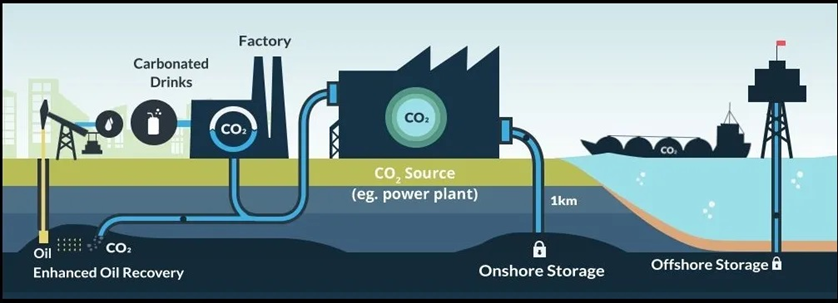
- Definition: CCUS is a suite of technologies designed to capture carbon dioxide emissions from large point sources (like power plants or factories) or directly from the atmosphere, and either reuse it or store it permanently underground.
- Objective: To prevent CO2 from entering the atmosphere and contributing to global warming, especially where switching to renewable energy is technically difficult.
2. The Three Stages of CCUS
- Capture: CO2 is separated from other gases produced at industrial facilities.
- Post-combustion: Capturing CO2 from flue gases after burning fossil fuels (most common for existing plants).
- Pre-combustion: Trapping CO2 before the fuel is fully burned (used in coal gasification).
- Oxy-fuel combustion: Burning fuel in nearly pure oxygen, resulting in a residue of almost pure CO2 and water vapor.
- Transport: The captured CO2 is compressed into a liquid-like state and moved via pipelines, ships, or trucks to a storage or utilization site.
- Utilisation or Storage:
- Utilisation (CCU): Converting CO2 into value-added products like Green Urea, synthetic fuels (methanol), building materials (carbonated concrete), or for Enhanced Oil Recovery (EOR).
- Storage (CCS): Injecting CO2 into deep geological formations such as depleted oil and gas fields, saline aquifers, or unmineable coal seams for permanent sequestration.
3. Budget 2026 Highlights & India’s Strategy
- Outlay: ₹20,000 crore allocated for the next five years (2026–2031).
- Target Sectors: Power, Steel, Cement, Refineries, and Chemicals.
- Technology Readiness Levels (TRL): The budget aims to move Indian innovations from TRL 3/4 (laboratory/pilot) to TRL 9 (commercial deployment).
- Blue Hydrogen: CCUS is the critical enabler for producing Blue Hydrogen (hydrogen produced from natural gas where the resulting CO2 is captured).
4. Key Challenges for India
- High Cost: CCUS is currently capital-intensive; CO2 capture alone can account for 70–80% of the total cost.
- Energy Penalty: Running a capture plant requires significant energy, which can reduce the net power output of a station.
Consider the following statements:
Statement I: Carbon Capture, Utilisation and Storage (CCUS) is considered a key technological option for achieving deep decarbonisation in hard-to-abate industrial sectors such as cement, steel, and chemicals.
Statement II: CCUS enables the capture of carbon dioxide from point sources and its permanent geological storage, thereby preventing its release into the atmosphere.
Statement III: CCUS allows captured carbon dioxide to be reused for industrial applications such as enhanced oil recovery, synthetic fuels, and building materials.

Which one of the following is correct in respect of the above statements?
(a) Both Statement II and Statement III are correct and both of them explain Statement I
(b) Both Statement II and Statement III are correct but only one of them explains Statement I
(c) Only one of the Statements II and III is correct and that explains Statement I
(d) Neither Statement II nor Statement III is correct

Correct Answer: (a)
Statement II is correct because CCUS directly reduces industrial carbon emissions by capturing CO₂ at the source and storing it in deep geological formations such as depleted oil and gas fields or saline aquifers. This permanent storage prevents greenhouse gases from entering the atmosphere, which is a core reason why CCUS is considered essential for decarbonising sectors where direct electrification is not feasible.
Statement III is also correct because CCUS includes the utilisation component, where captured CO₂ is converted into value-added products such as synthetic fuels, chemicals, carbonated concrete, and is also used for enhanced oil recovery. This reuse improves the economic viability of CCUS and supports industrial adoption.
BOTH STATEMENTS II AND III EXPLAIN STATEMENT I: Together, they justify why CCUS is viewed as a key decarbonisation tool for hard-to-abate industries. The combination of permanent carbon storage and productive utilisation explains its strategic importance in climate mitigation frameworks, thereby correctly explaining Statement I.