
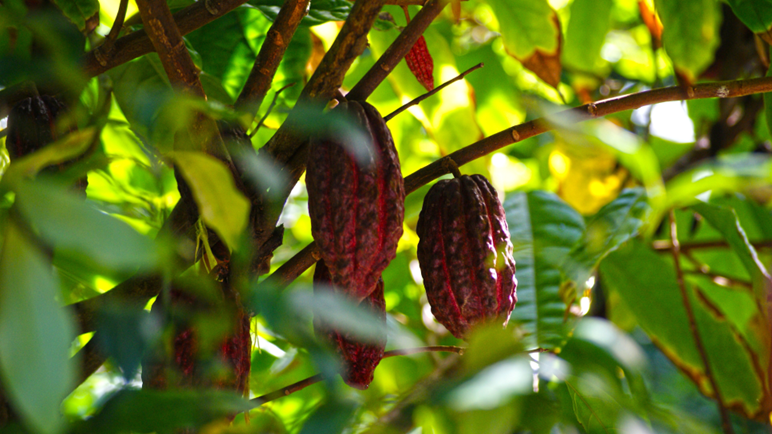
Context
Recently, the Union Finance Minister announced a dedicated mission for cocoa and cashew in the Union Budget 2026-27 to make India self-reliant in production and processing by 2030. According to The Hindu and The Indian Express, cocoa has gained significant attention due to a 2025-26 global price surge- reaching record highs of over USD 10,000 per tonne-triggered by severe supply deficits in West Africa.
The “Cocoa Promotion Scheme” aims to boost domestic productivity through the replacement of old trees and integration with the “Link South” agri-policy, particularly in coastal and hilly regions of Southern India.
1. Geographical and Climatic Requirements
- Origin: The cocoa tree (Theobroma cacao) is native to the Amazon rainforest of South America.
- The Cocoa Belt: It thrives in a narrow band known as the “Cocoa Belt,” located within 20 degrees north and south of the Equator.
- Temperature: It requires high temperatures ranging between 18°C and 32°C. It is highly sensitive to frost and extreme heat above 35°C.
- Rainfall: Optimal growth occurs with well-distributed annual rainfall between 1500 mm and 2000 mm.
- Humidity: A hot and humid atmosphere is essential, with relative humidity levels often reaching 100% during the day.
- Shade Requirement: Cocoa is traditionally an under-storey crop (shade-loving) and requires about 40–50% shade, which is why it is often intercropped with coconut and arecanut.
- Soil: It prefers deep, well-drained, nutrient-rich soils with a pH between 6.5 and 7.0.
2. Global Production Status (2025-26)
- Leading Producers: West Africa accounts for approximately 70% of global production. The top three producers are Ivory Coast (Côte d’Ivoire), Ghana, and Indonesia.
- Rising Contenders: Ecuador has recently emerged as a significant player, overtaking traditional rankings due to better productivity.
- The 2026 Crisis: Production in West Africa has been hit by the Swollen Shoot Virus, Black Pod disease, and extreme weather (El Niño), leading to a global supply shortage and record-high prices.
3. Cocoa in India
- Major Producing States: India is the 15th largest producer globally. Within India, Andhra Pradesh is the largest producer (accounting for over 40% of production), followed by Kerala, Karnataka, and Tamil Nadu.
- Intercropping Model: In India, cocoa is predominantly grown as an intercrop in coconut and arecanut plantations, providing farmers with an additional income stream.
- Trade Position: India is a net importer of cocoa. Domestic production meets only about 20–25% of the total industry demand of 50,000 MT per annum, with the remainder imported from West Africa and Southeast Asia.
- Varieties: The three main varieties cultivated are:
- Forastero: Most common (90% of global production), hardy and high-yielding.
- Criollo: Premium quality, delicate, and prone to disease.
- Trinitario: A hybrid of the two.
Q. With reference to the cultivation of Cocoa in India, consider the following statements:
1. In India, Andhra Pradesh is currently the leading producer of cocoa, surpassing traditional growers like Kerala.
2. Cocoa is primarily grown as a monoculture crop in the hilly regions of the North East to maximize sunlight exposure.
3. The Union Budget 2026-27 has proposed a dedicated mission to make India self-reliant in cocoa production by 2030.
4. India is a net exporter of cocoa beans, significantly contributing to the foreign exchange reserves through its premium "Criollo" variety.

Which of the statements given above are correct?
(a) Only one statement
(b) Only two statements
(c) Only three statements
(d) All four statements

Correct Answer: (b) Only two statements
Explanation
STATEMENT 1 IS CORRECT: Andhra Pradesh has emerged as the leading producer of cocoa in India, leveraging its extensive coconut and arecanut plantations for intercropping.
STATEMENT 2 IS INCORRECT: Cocoa is a shade-loving crop and is primarily grown as an intercrop (not monoculture) in Southern India. While the government is exploring the North East, the crop requires protection from direct wind and intense sun.
STATEMENT 3 IS CORRECT: The Union Budget 2026-27 explicitly announced a program for cocoa to enhance domestic production and processing.
STATEMENT 4 IS INCORRECT: India is a net importer of cocoa, as domestic production satisfies only a small fraction of the total demand from the chocolate industry.