
Context
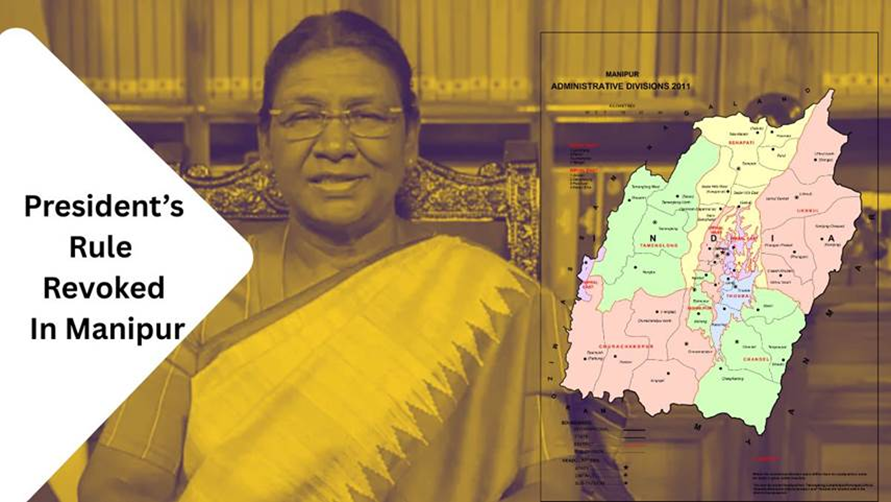
Recently, the Union Government issued a notification revoking President’s Rule in Manipur on February 4, 2026, following nearly a year of direct central administration. This move comes after the election of Yumnam Khemchand Singh as the leader of the ruling party, paving the way for the restoration of a popular elected government in the state.
1. Constitutional Provisions
- Article 355: Imposes a duty on the Union to protect every state against external aggression and internal disturbance and to ensure that the government of every state is carried on in accordance with the provisions of the Constitution.
- Article 356: Empowers the President to issue a proclamation if they are satisfied (based on a report from the Governor or “otherwise”) that a situation has arisen where the state government cannot be carried on in accordance with the Constitution.
- Article 365: Provides that whenever a state fails to comply with or give effect to any direction from the Centre, it shall be lawful for the President to hold that a situation has arisen in which the government of the state cannot be carried on in accordance with the Constitution.
2. Parliamentary Approval and Duration
- Approval Timeline: A proclamation must be approved by both Houses of Parliament within two months from the date of its issue.
- Majority Required: It must be approved by a Simple Majority (majority of the members of that House present and voting).
- Initial Period: Once approved, it continues for six months. It can be extended for a maximum period of three years with repeated parliamentary approval every six months.
- 44th Amendment Act (1978) Restraint: Extension beyond one year is only possible if:
- A Proclamation of National Emergency is in operation in the whole of India or the state.
- The Election Commission certifies that the holding of general elections to the legislative assembly is difficult.
3. Consequences of President’s Rule
- Executive Power: The President dismisses the state council of ministers headed by the chief minister. The Governor, on behalf of the President, carries on the state administration with the help of the chief secretary or advisors appointed by the President.
- Legislative Power: The state legislative assembly is either suspended or dissolved. The Parliament passes the state legislative bills and the state budget.
- Judicial Power: The President cannot assume the powers vested in the High Court or suspend the operation of any constitutional provisions relating to High Courts.
4. Judicial Review: S.R. Bommai Case (1994)
The Supreme Court laid down several guidelines to prevent the misuse of Article 356:
- The proclamation is subject to judicial review.
- The satisfaction of the President must be based on relevant material.
- The burden of proof lies on the Centre to justify the imposition.
- If the court finds the proclamation unconstitutional, it has the power to revive the dismissed state government and restore the dissolved assembly.
- The state assembly should be dissolved only after Parliament has approved the proclamation.
5. Comparison between National Emergency and President Rule
| Feature | National Emergency (Article 352) | President’s Rule (Article 356) |
| Grounds of Imposition | War, External Aggression, or Armed Rebellion. | Failure of Constitutional Machinery in the state (Art. 356) or failure to comply with Union directions (Art. 365). |
| Scope | Can be applied to the entire country or a part of it. | Applied only to a specific state. |
| Parliamentary Approval | Must be approved within one month. | Must be approved within two months. |
| Majority Required | Special Majority (50% of total + 2/3rd of members present & voting). | Simple Majority (Majority of members present and voting). |
| Maximum Duration | Indefinite (with 6-monthly approval). | Maximum 3 years (with 6-monthly approval). |
| State Government | State executive and legislature continue to function, but the Centre gets concurrent power. | State Executive is dismissed; State Legislature is suspended or dissolved. |
| Fundamental Rights | Affects Fundamental Rights (Art. 358 & 359). Art. 20 & 21 can never be suspended. | No effect on Fundamental Rights of citizens. |
| Law-making Power | Parliament can make laws on State List; power cannot be delegated to others. | Parliament can make laws on State List and can delegate this power to the President. |
| Revocation | Can be revoked by the President or by Lok Sabha passing a resolution for disapproval. | Can be revoked by the President alone. No specific provision for Lok Sabha to force revocation. |
Q. With reference to the imposition of President’s Rule in a state under Article 356, consider the following statements:
I. A proclamation of President’s Rule must be approved by a special majority in both Houses of Parliament within two months.
II. The President has the power to revoke the proclamation at any time through a subsequent proclamation, which does not require parliamentary approval.
III. During President’s Rule, the Parliament can delegate the power to make laws for the state to the President or any other authority specified by him.

Which of the statements given above are correct?
A) I and II only
B) II and III only
C) I and III only
D) I, II, and III

Answer: B) 2 and 3 only
Solution:
STATEMENT I IS INCORRECT: While the timeline of two months is correct, the proclamation of President’s Rule requires only a Simple Majority (not a special majority) for approval in both Houses of Parliament.
STATEMENT II IS CORRECT: Under Article 356(2), a proclamation may be revoked or varied by a subsequent proclamation by the President. This revocation does not require the approval of Parliament.
STATEMENT III IS CORRECT: Under Article 357, when President’s Rule is in force, the Parliament can confer the power of the State Legislature on the President and authorize him to delegate this power to other authorities.