
Context
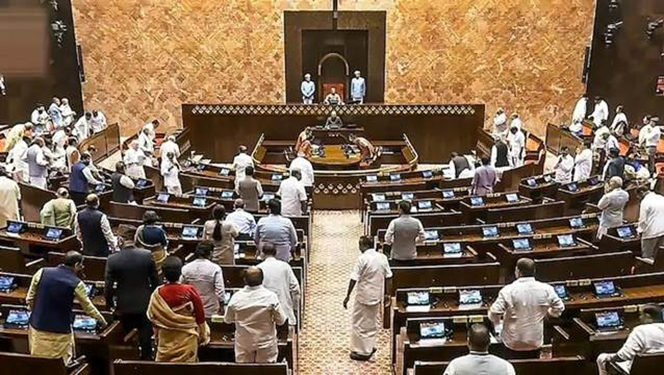
Recently, the Election Commission of India (ECI) announced biennial elections for 37 Rajya Sabha seats across 10 states, including Maharashtra, Tamil Nadu, and West Bengal, with polling scheduled for March 16, 2026.
1. Constitutional Framework
- Article 80: Deals with the composition of the Council of States (Rajya Sabha).
- Maximum Strength: 250 members (238 representing States/UTs and 12 nominated by the President).
- Current Strength: 245 members (233 elected, 12 nominated).
- Fourth Schedule: Specifies the allocation of seats to each State and Union Territory based on population.
2. The Election Process
- Electorate: The representatives of each State are elected by the elected members of the State Legislative Assembly (MLAs). Nominated members of the Assembly do not participate.
- System of Election: Proportional Representation by means of a Single Transferable Vote (STV).
- The Quota System: To win, a candidate needs a specific number of votes (Quota).
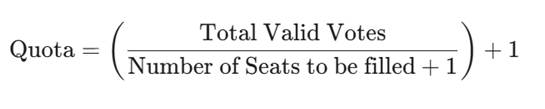
- Voting Method: Each voter (MLA) marks preferences (1, 2, 3…) against the names of candidates. If a candidate reaches the quota with first-preference votes, they are elected. Surplus votes are then transferred to the next preferred candidate.
3. Key Legal Provisions (RPA 1951 & Amendments)
- Open Ballot System (2003): To curb “cross-voting” and corruption, the secret ballot was replaced with an open ballot. An MLA belonging to a political party must show their marked ballot paper to the authorized agent of that party.
- Domicile Requirement: The 2003 amendment removed the requirement that a candidate must be an elector in the same state from which they are contesting. A person can now contest from any state as long as they are a registered voter in any parliamentary constituency in India.
- Cross-Voting & Anti-Defection: Interestingly, the Supreme Court (Kuldip Nayar case) held that voting against the party’s direction in Rajya Sabha elections does not automatically attract disqualification under the Tenth Schedule (Anti-Defection Law), though the party can take disciplinary action.
4. Duration and Nature of the House
- Permanent Body: Unlike the Lok Sabha, the Rajya Sabha is not subject to dissolution.
- Staggered Terms: Members are elected for a six-year term, with one-third of the members retiring every two years.
Q. With reference to the election of members to the Rajya Sabha, consider the following statements:

1. The representatives of the States are elected by both elected and nominated members of the State Legislative Assemblies.
2. The election is held through a secret ballot to ensure the independence of the legislators.
3. A candidate contesting for a seat in a particular State must be a registered elector in that same State.
4. The system of Proportional Representation by means of a Single Transferable Vote is utilized.

Which of the statements given above is/are correct?

A) 4 only
B) 2 and 4 only
C) 1, 2 and 3 only
D) 1 and 4 only

Solution: A

•	STATEMENT 1 INCORRECT: Only elected members of the State Legislative Assembly (MLAs) participate; nominated members are excluded.
•	STATEMENT 2 INCORRECT: Rajya Sabha elections use an Open Ballot system (since 2003) to prevent cross-voting.
•	STATEMENT 3 INCORRECT: After the 2003 amendment to the RPA 1951, a candidate can be an elector in any parliamentary constituency in India, not necessarily the state they are contesting from.
•	STATEMENT 4 CORRECT: The Constitution explicitly mandates Proportional Representation by means of the Single Transferable Vote (STV) for the Rajya Sabha.