
Context
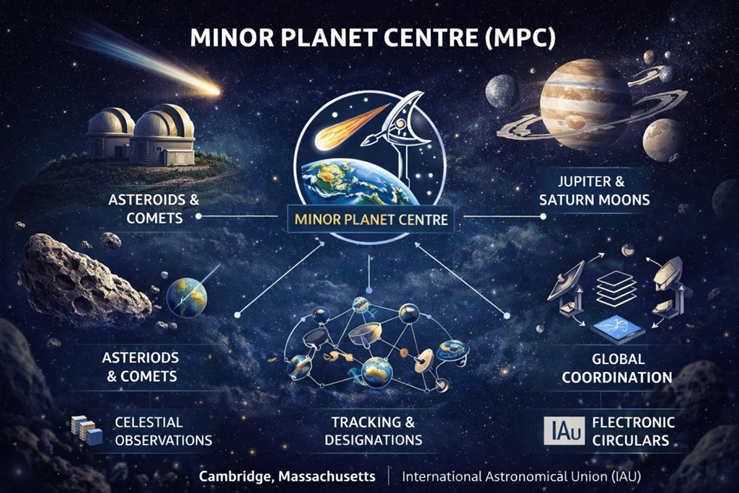
The Minor Planet Centre (MPC) recently announced the discovery of 15 new moons: 4 orbiting Jupiter and 11 orbiting Saturn.
1. The Minor Planet Centre (MPC)
- Primary Role: It serves as the world’s single repository for all observations of small bodies in the solar system, including asteroids, comets, and the moons of outer planets.
- Location & Operation: Located in Cambridge, Massachusetts, it operates at the Smithsonian Astrophysical Observatory.
- Institutional Affiliation: It functions under the auspices of the International Astronomical Union (IAU).
- Designation Process: When a new object is discovered, the MPC verifies the observation, calculates the orbit, and assigns an official designation to ensure every minor planet has a unique identity.
2. Near-Earth Objects (NEOs) & Planetary Defense
- Monitoring: One of the MPC’s most critical tasks is tracking Near-Earth Objects (NEOs)—space rocks that could potentially threaten Earth.
- Collaboration: It maintains a massive database with support from NASA’s Planetary Defense Coordination Office.
- Predictive Science: The data allows scientists to predict if and when a celestial rock might come dangerously close to our planet.
3. Global Coordination
- Communication: The MPC facilitates global scientific communication by publishing electronic circulars.
- Alert System: These circulars alert researchers to new discoveries or interesting celestial events, allowing observatories worldwide to coordinate efforts quickly.
Consider the following statements regarding the Minor Planet Centre:

1. It is the global repository for observations of small solar system bodies.
2. It operates under NASA.
3. It assigns official designations to newly discovered celestial objects.

Which of the statements given above is/are correct?
(a) 1 and 3 only
(b) 2 and 3 only
(c) 1 only
(d) 1, 2 and 3

Answer: A

Explanation:
•	Statement 1 is correct: The Minor Planet Centre (MPC) is the single worldwide location for all observations and data related to small bodies in the solar system, such as asteroids, comets, and natural satellites of the outer planets.
•	Statement 2 is incorrect: While the MPC receives support from NASA (specifically through the Planetary Defense Coordination Office), it officially operates at the Smithsonian Astrophysical Observatory under the auspices of the International Astronomical Union (IAU). It is not a direct sub-agency of NASA.
•	Statement 3 is correct: One of the core functional roles of the MPC is to verify observations, calculate orbits, and assign official designations (identities) to newly discovered minor planets and other celestial objects.