
Context
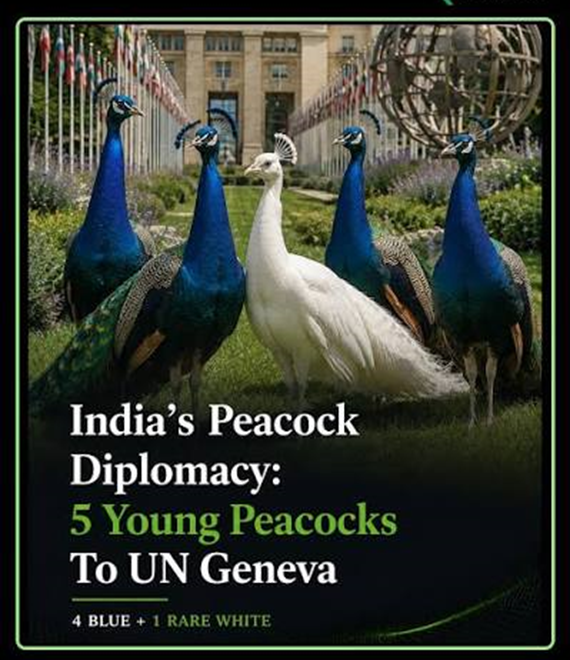
- India has donated five peacocks, including a rare white-feathered male, to the United Nations Office at Geneva (UNOG). The donation revives a decades-old tradition and highlights the peacock’s significance as both a national symbol of India and a representation of the country’s rich biodiversity.
About Indian Peacock
- Scientific name: Pavo cristatus
- Family: Phasianidae
- National status: National Bird of India
- Declared National Bird: 1963
- IUCN Red List: Least Concern
- Legal protection in India: Protected under the Wild Life (Protection) Act, 1972
- Diet: Omnivorous, feeding on seeds, grains, fruits, insects and small animals.
- Habitat: Open forests, scrublands, agricultural landscapes and areas close to human habitation.
Why was the Peacock chosen as India’s National Bird?
- The choice reflects its wide distribution, distinctive appearance and deep association with Indian culture and traditions. The peacock has long featured in Indian art, architecture, mythology and religious traditions.
The Peacock’s Distinctive Features
- The male peacock is particularly known for its long ornamental train, which displays numerous eye-like spots or ocelli.
- The train is primarily associated with courtship and sexual selection. The striking plumage makes the peacock one of the most recognisable birds associated with India.
Conservation Significance
- Although the Indian Peacock is classified as Least Concern by the IUCN, it enjoys significant protection under India’s domestic wildlife legislation.
International Significance of the Donation
- The donation to UNOG in Geneva gives the initiative a broader diplomatic and environmental dimension.
- It brings together three themes: National Symbol → Biodiversity → International Environmental Diplomacy
- The peacock therefore serves not merely as a cultural emblem but also as a symbol of India’s commitment to biodiversity conservation and environmental stewardship.
Q. With reference to the Indian Peacock, consider the following statements:
1. The Indian Peacock is scientifically known as Pavo cristatus.
2. The Indian Peacock is classified as Least Concern in the IUCN Red List.
3. The white Peacock is recognised as a separate species from the Indian Peacock.
4. The Indian Peacock was declared the National Bird of India in 1963.
Which of the statements given above are correct?
A. 1, 2 and 4 only
B. 1 and 3 only
C. 2, 3 and 4 only
D. 1, 2, 3 and 4
Answer: A. 1, 2 and 4 only
• Statement 1 is Correct: Indian Peacock → Pavo cristatus.
• Statement 2 is Correct: It is listed as Least Concern (LC) by the IUCN.
• Statement 3 is Incorrect: The white Peacock is not a separate species; its white plumage is associated with genetic variation.
• Statement 4 is Correct: The Indian Peacock was declared India's National Bird in 1963.