
Context
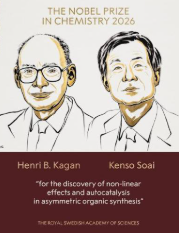
- Henri B. Kagan (France) and Kenso Soai (Japan) received the 2026 Nobel Prize in Chemistry for discovering non-linear effects and autocatalysis in asymmetric organic synthesis, helping explain homochirality—why life predominantly uses one mirror-image form of certain molecules.
What is Chirality?
- Chirality refers to the property of an object or molecule that is not identical to its mirror image.
- The two mirror-image forms of a chiral molecule are called enantiomers.
- A simple example is the left and right hand—they are mirror images but cannot be perfectly superimposed.
- Many biologically important molecules, including amino acids, are chiral.
- Biological systems often preferentially use one specific enantiomer.
- This molecular “handedness” is known as homochirality when one form predominates in a biological system.
Why is Chirality Important?
- Chirality is important because biological systems are completely asymmetrical, meaning two mirror-image molecules will fit into body receptors differently—like a left hand trying to fit into a right-handed glove.
- This is particularly important in pharmaceuticals, where one molecular form may produce the desired therapeutic effect while another may have a different or undesirable effect.
- Therefore, controlling which enantiomer is produced is crucial for drug development and manufacturing.
- Chirality is also important in the production of flavours, fragrances and advanced materials.
Advanced Chemical Principles & Innovations
- Asymmetric Amplification (Kagan’s Discovery – 1986):
- Demonstrates that even a slight initial imbalance in the handedness of a chiral catalyst can disproportionately bias the final chemical reaction to yield a specific desired form.
- Enables high-efficiency production of specific enantiomers for pharmaceuticals, agrochemicals, and fragrances.
- Asymmetric Autocatalysis (Soai Reaction – 1990s):
- Occurs when a chiral molecule serves as its own catalyst, accelerating the formation of identical chiral forms.
- Helps explain the evolutionary origins of why life prefers single-handed molecular forms.
Significance of the Discovery
- Pharmaceuticals: Enables greater control over the production of desired enantiomers.
- Organic synthesis: Provides methods to selectively produce chiral molecules.
- Origin of life: Offers insights into the emergence of homochirality.
- Chemical catalysis: Demonstrates how molecular asymmetry can be amplified through catalytic processes.
Materials and technology: Chiral molecules are increasingly relevant in the development of new materials and technological applications.
Q. With reference to 'Chirality' and chemical reactions, consider the following statements:

1. Chiral molecules are mirror-image forms of each other that interact identically with human cell receptors.
2. In asymmetric catalysis, a minor structural imbalance in a catalyst can disproportionately determine the end product's optical form.
3. The majority of proteins in the human body are made of amino acids displaying a specific hand-like orientation.

Which of the statements given above is/are correct?
(a) 1 only
(b) 2 and 3 only
(c) 1 and 3 only
(d) 1, 2 and 3

Answer: (b) 2 and 3 only

• Statement 1 is incorrect: Chiral molecules are mirror-image forms of each other (enantiomers) that interact differently with chiral receptors and enzymes in human cells. Because cell receptors and enzymes are chiral, two mirror-image forms of a molecule can trigger distinct biological responses.
• Statement 2 is correct: In asymmetric catalysis, a minor initial imbalance or asymmetry in the catalyst can disproportionately bias the reaction, determining the optical form/handedness of the end product.
• Statement 3 is correct: Living organisms display homochirality; specifically, the majority of proteins in the human body are composed of amino acids with a specific hand-like orientation.