
Context
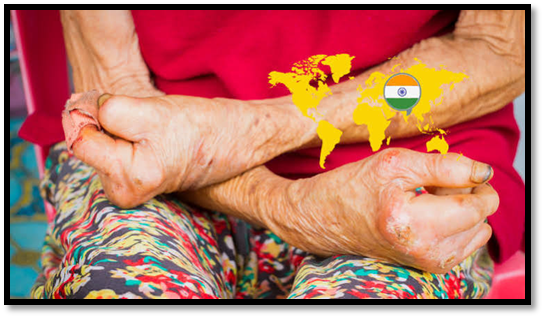
- India has achieved national-level leprosy elimination, but transmission persists in some pockets. Under the National Strategic Plan 2023–2027, India aims for zero transmission, zero disability and zero discrimination by 2027.
About Leprosy
- Leprosy, or Hansen’s disease, is a chronic infectious disease caused mainly by the bacterium Mycobacterium leprae.
- Leprosy is classified by WHO as a Neglected Tropical Disease (NTD).
- It primarily affects the skin and peripheral nerves, and may also affect the mucosa of the upper respiratory tract and eyes.
- Untreated infection can cause permanent nerve damage, deformities and disability.
- Leprosy is mainly transmitted through droplets from the nose and mouth of an untreated person following prolonged and close contact.
- Leprosy is curable and not highly contagious, especially once treatment begins.
- India, Brazil and Indonesia continue to account for a major share of newly detected cases globally.
- The WHO Global Leprosy Strategy 2021–2030 aims at moving towards zero leprosy, with emphasis on interrupting transmission, preventing disability and eliminating stigma.
National Leprosy Eradication Programme (NLEP)
- Launched: 1983 by the Government of India.
- Objective: To eliminate leprosy as a public health problem and prevent disability.
- Nodal Ministry: Ministry of Health & Family Welfare.
- Key Strategy: Early detection, free multidrug therapy (MDT) and contact tracing.
- Focus: Preventing transmission, reducing stigma and providing disability prevention & rehabilitation.
- Target: India aims for zero transmission, zero disability and zero stigma related to leprosy.
Treatment of Leprosy
- Main treatment: Multidrug Therapy (MDT) using a combination of antibiotics.
- Paucibacillary (PB) leprosy: Rifampicin + Dapsone.
- Multibacillary (MB) leprosy: Rifampicin + Dapsone + Clofazimine.
- Treatment duration: Usually 6 months for PB and 12 months for MB under WHO-recommended regimens.
- Free treatment: MDT is provided free of cost through public health programmes in India.
India’s Current Progress
- Prevalence Rate: declined from 0.69 per 10,000 in 2014–15 to 0.57 in 2024–25.
- Grade-II disability among new cases: declined from 4.48 per million to 1.31 per million during the same period.
- Child cases among new cases: declined from 9.04% to 4.68%.
- 638 districts had achieved the elimination-level prevalence threshold by 2024–25.
| Important CTC from this article for UPSC: Leprosy |
Q. Consider the following statements regarding leprosy in India:
1. Leprosy is caused mainly by Mycobacterium leprae and primarily affects the skin and peripheral nerves.
2. Multidrug Therapy (MDT) for leprosy includes rifampicin, dapsone and clofazimine.
3. India’s achievement of elimination of leprosy as a public-health problem implies complete eradication of the disease from the country.
4. Single-Dose Rifampicin can be used as post-exposure prophylaxis for eligible contacts of leprosy patients.
Which of the statements given above are correct?
(a) 1, 2 and 3 only
(b) 1, 2 and 4 only
(c) 2, 3 and 4 only
(d) 1, 2, 3 and 4
Answer: (b) 1, 2 and 4 only
• Statement 1 is Correct: Leprosy is mainly caused by Mycobacterium leprae and commonly affects the skin and peripheral nerves.
• Statement 2 is Correct: MDT uses rifampicin, dapsone and clofazimine.
• Statement 3 is Incorrect: Elimination as a public-health problem means achieving a prevalence of less than 1 case per 10,000 population; it does not mean complete eradication.
• Statement 4 is Correct: Single-Dose Rifampicin (SDR) is used as post-exposure prophylaxis for eligible contacts.