
Context
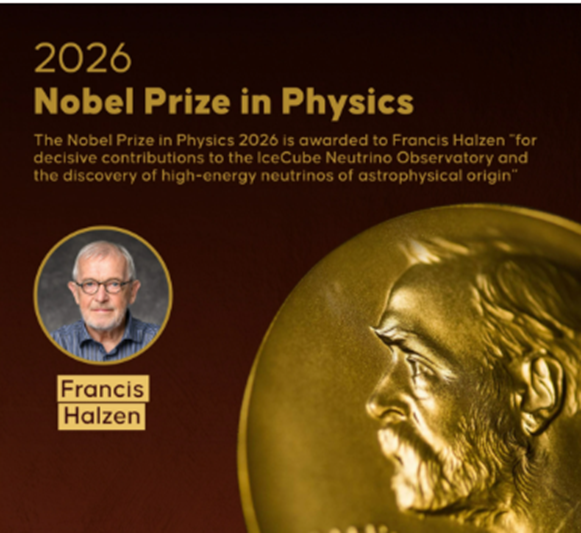
- The 2026 Nobel Prize in Physics is being awarded to Francis Halzen for his pioneering contributions to the IceCube Neutrino Observatory and the discovery of high-energy neutrinos of astrophysical origin.
About the IceCube Neutrino Observatory
- IceCube is a giant neutrino detector located at the South Pole in Antarctica.
- It is designed primarily to detect high-energy astrophysical neutrinos originating from distant and energetic cosmic events.
- The observatory occupies nearly 1 cubic kilometre of Antarctic ice.
- It contains around 5,160 optical sensors embedded deep in the ice.
- IceCube was completed in 2010.
Why Neutrinos are Important?
- Neutrinos are extremely elusive subatomic particles with very weak interactions with matter.
- They can travel enormous cosmic distances without being significantly deflected or absorbed.
- High-energy neutrinos can therefore provide information about violent astrophysical environments that cannot be studied adequately through conventional electromagnetic astronomy.
Why is Ice Used to Detect Neutrinos?
- Antarctic ice offers a vast and exceptionally transparent medium for detecting the faint flashes of light produced by neutrino interactions.
- When a neutrino interacts with matter in the ice, it can produce charged particles that emit Cherenkov light.
- Light sensors embedded deep in the ice detect these faint flashes.
- By analysing these signals, scientists can determine the energy and direction of the neutrino and trace its cosmic origin.
About Cherenkov Radiation
- Cherenkov light is the characteristic blue light produced when a charged particle travels through a transparent medium faster than light can travel through that medium.
- It does not mean that the particle travels faster than light in vacuum.
- IceCube uses this light to reconstruct the direction and energy of neutrino interactions.
| Important CTC From this Article- Neutrino |
Q. With reference to the IceCube Neutrino Observatory, consider the following statements:
1. It is located in the Arctic region.
2. It detects Cherenkov light produced by neutrino interactions in ice.
3. Its main focus is on high-energy astrophysical neutrinos.
Which of the statements given above are correct?
(a) 1 and 2 only
(b) 2 and 3 only
(c) 1 and 3 only
(d) 1, 2 and 3
Answer: B
• Statement 1 is incorrect. IceCube is at the South Pole, in Antarctica, not the Arctic.
• Statement 2 is correct. Its 5,160 optical sensors detect Cherenkov light, the pale blue flash produced when charged particles from a neutrino collision travel through the ice faster than light does in that medium.
• Statement 3 is correct. Its principal scientific focus is high-energy astrophysical (cosmic) neutrinos, such as the ones first reported in 2013 and the one traced to a blazar in 2018.