
Context
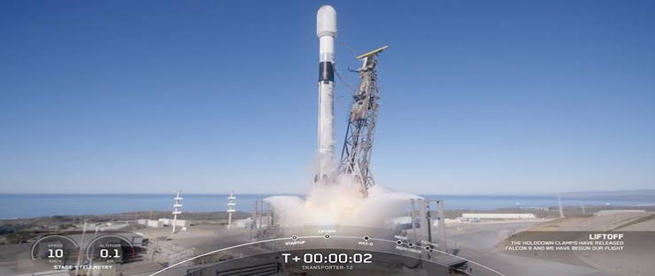
- Recently, multiple Indian payloads were launched on SpaceX’s Falcon 9 from Vandenberg Space Force Base, California, as part of the Transporter-18 rideshare mission.Dhruva Space’s LEAP-2 mission was among them, hosting multiple in-orbit demonstration (IOD) payloads.
About the Transporter-18 Mission
- Type: A rideshare mission, meaning multiple customers share the same rocket.
- Vehicle: Falcon 9, SpaceX’s reusable two-stage rocket.
- Launch site: Space Launch Complex 4E, Vandenberg Space Force Base, California.
- Scale: About 130 payloads were carried.
- Orbit: A dedicated smallsat rideshare to Sun-synchronous orbit (SSO).
About LEAP (Launching Expeditions for Aspiring Payloads)
- Full form: Launching Expeditions for Aspiring Payloads.
- Developer: Dhruva Space, a private Indian space company.
- Concept: A hosted-payload model. Instead of building a whole satellite for one instrument, a customer fits it onto Dhruva’s ready-made satellite bus, called P-30.
- Services: Dhruva also handles launch integration, ground station support and mission management.
- Earlier missions:
- LEAP-TD (technology demonstrator) flew on ISRO’s PSLV-C58 in 2024.
- LEAP-1, Dhruva’s first commercial mission, flew on a Falcon 9 in August 2025.
- LEAP-2: Carries four payloads, including a star tracker from France’s Sodern.
Other Indian Payloads on the Mission
- TAPAS-1 (SatLeo Labs): A thermal-imaging payload that flew aboard LEAP-2. It is described as India’s first commercial CubeSat thermal payload.
- MOI-1A (TakeMe2Space): A satellite designed to process Earth observation data in orbit using AI. It carried EON Space Labs’ MIRA multi-spectral imaging system.
- Background: TakeMe2Space’s first satellite, MOI-1, was lost on ISRO’s PSLV-C62 in January 2026.
- Regulator: All three Indian missions were authorised by IN-SPACe.
| Important CTC from this article for UPSC: Falcon 9 |
Q. With reference to the recent Transporter-18 mission, consider the following statements:
I. It was a rideshare mission in which multiple customers shared a single Falcon 9 launch.
II. Dhruva Space’s LEAP platform allows smaller payloads to be hosted on a single satellite for in-orbit demonstration.
III. IN-SPACe is the commercial arm of ISRO that markets ISRO’s products and services.
Which of the statements given above is/are correct?
(a) I and II only
(b) II and III only
(c) I and III only
(d) I, II and III
Answer: (a)
Explanation
• Statement I is correct: Transporter-18 was a rideshare mission with about 130 payloads from multiple customers on one rocket.
• Statement II is correct: LEAP (Launching Expeditions for Aspiring Payloads) hosts several small payloads on one P-30 bus for IOD.
• Statement III is incorrect: The commercial arm of ISRO is NewSpace India Limited (NSIL). IN-SPACe is the autonomous regulator and promoter of private space activity under the Department of Space.