
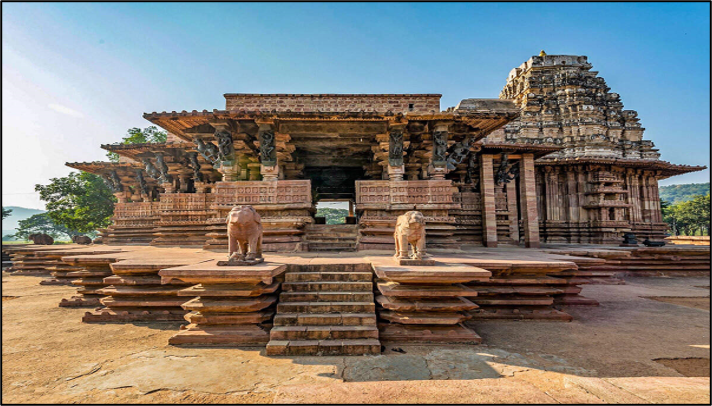
Context
- Activists have raised concerns over a proposed open-cast coal mine near Venkatapur in Mulugu district of Telangana, arguing that mining activity could adversely affect the Rudreshwara Temple, popularly known as Ramappa Temple, and the adjoining Ramappa Lake.
About Ramappa Temple
- The Rudreshwara Temple, popularly known as the Ramappa Temple, is located at Palampet in Mulugu district, Telangana.
- It was built during the Kakatiya period in the 13th century.
- The temple is dedicated to Lord Shiva.
- It is popularly named after Ramappa, the chief sculptor associated with its construction.
- The temple is noted for its intricate sculptures, ornamental carvings and distinctive architectural techniques.
- The temple complex is located near the Ramappa Lake, a historic water-management structure associated with the Kakatiya period.
UNESCO World Heritage Status
- The Rudreshwara (Ramappa) Temple was inscribed on the UNESCO World Heritage List in 2021.
- It is significant because it represents the architectural and cultural achievements of the Kakatiya dynasty.
Kakatiya Architecture: Key Features
- Star-shaped plan: Temples often have a distinctive stellate (star-shaped) ground plan.
- Material: Extensive use of locally available granite and sandstone, with highly polished stone surfaces.
- Intricate carvings: Rich floral, geometric, mythological and figurative sculptures adorn walls and pillars.
- Lathe-turned pillars: Highly polished, finely carved circular pillars are a prominent feature.
- Raised platforms: Temples were often built on elevated platforms (jagati).
- Distinctive gateways: Elaborate entrances and toranas, especially seen at the Warangal Fort.
- Open-pillared halls: Spacious mandapas with numerous ornate pillars were used for religious gatherings.
- Water architecture: Kakatiyas developed tanks, reservoirs and stepped wells, reflecting their expertise in water management.
- Notable examples: Thousand Pillar Temple, Ramappa Temple, and Warangal Fort.
| Important Current to Concept (CTC) from this article for UPSC: Ramappa Temple Kakatiya Dynasty |
Q. With reference to the Kakatiya Rudreshwara (Ramappa) Temple, consider the following statements:
1. It is built in close proximity to a historic irrigation lake developed by the Kakatiyas.
2. The superstructure of the temple was constructed using porous, lightweight bricks capable of floating on water.
3. The temple utilizes a specialized sandbox foundation technique to absorb seismic vibrations.
4. It was commissioned during the reign of Kakatiya ruler Prataparudra I.
Which of the statements given above are correct?
(a) 1, 2, and 3 only
(b) 2 and 4 only
(c) 1, 3, and 4 only
(d) 1, 2, 3, and 4
Answer: (a) 1, 2, and 3 only
Explanation:
• Statements 1, 2, and 3 are correct: The temple sits adjacent to the Kakatiya-era Ramappa Lake, incorporates floating lightweight bricks in its vimana, and relies on a sandbox foundation to buffer against seismic tremors.
• Statement 4 is incorrect: It was commissioned in 1213 CE during the reign of Kakatiya King Ganapati Deva by his general Recherla Rudra, not Prataparudra I.