
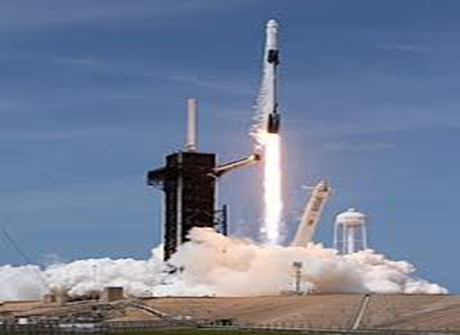
About the Falcon 9 Launch Vehicle
- Definition: Two-stage, partially reusable, medium-lift orbital launch vehicle.
- Developer: SpaceX, designed and built in-house.
- Propellants: Liquid oxygen (LOX) and rocket-grade kerosene (RP-1).
- Design Goals: High reliability, reusability and low-cost access to space.
| Parameter | Detail |
| First Flight | 4 June 2010 (v1.0) |
| Current Variant | Block 5 (first flew 11 May 2018) |
Vehicle Architecture & Propulsion
- First Stage: Nine Merlin 1D engines in an “Octaweb” pattern (eight around one central engine), giving about 7,607 kN (~1.71 million lbf) of thrust at liftoff.
- Second Stage: A single vacuum-optimised Merlin (MVac) engine with dual-redundant pyrophoric TEA-TEB igniters, enabling restart in orbit.
- Structures & Staging: Tanks of friction-stir-welded aluminium-lithium alloy; interstage of carbon-fibre composite over an aluminium core; stage and fairing separation by pneumatic systems instead of pyrotechnics.
Reliability & Safety Features
- Human-Rating Margins: Built to NASA human-rating requirements, with a structural factor of safety of 1.4 against the standard 1.25 for uncrewed rockets.
- Avionics & Flight Controls: Single-fault-tolerant architecture with triplicated units and redundant lithium-ion battery strings.
- Engine-Out Capability: Flight software can shut down an off-nominal first-stage engine during ascent and reshape the trajectory to complete the mission.
Reusability & Recovery Operations
- Recovery Hardware: Four grid fins near the top for aerodynamic guidance during re-entry and four deployable landing legs at the base.
- Landing Modes: Controlled re-entry burns, then landing on offshore autonomous drone ships or at land pads such as Landing Zone 4 (LZ-4) at Vandenberg Space Force Base.
- Second Stage: Expended on every flight; only the first stage is recovered.
Orbits, Launch Sites & Licensing
- Orbits Served: Payloads in the 5.2 m fairing reach low Earth orbit (LEO), sun-synchronous orbit (SSO), polar orbit, geosynchronous transfer orbit (GTO) and Earth-escape trajectories.
- Launch Infrastructure: SLC-40 at Cape Canaveral, LC-39A at Kennedy Space Center and SLC-4E at Vandenberg Space Force Base.
- Regulatory Licensing: Flies under FAA Vehicle Operator License LLO 18-111; the authorised Vandenberg cadence rose from 36 to 50 launches a year, and in October 2025 the Department of the Air Force approved up to 100 Falcon 9/Falcon Heavy launches a year across SLC-4 and SLC-6.
Conclusion
The Falcon 9 is SpaceX’s two-stage, partially reusable launch vehicle fuelled by LOX and RP-1, with nine Merlin 1D engines on the first stage and one MVac on the second. Its human-rated safety margins, recoverable first stage and three launch complexes — SLC-40, LC-39A and SLC-4E — define its role as a reliable, lower-cost orbital launcher.
| This concept has been elaborately discussed in the following article – Indian Payloads on SpaceX’s Transporter |