
Context
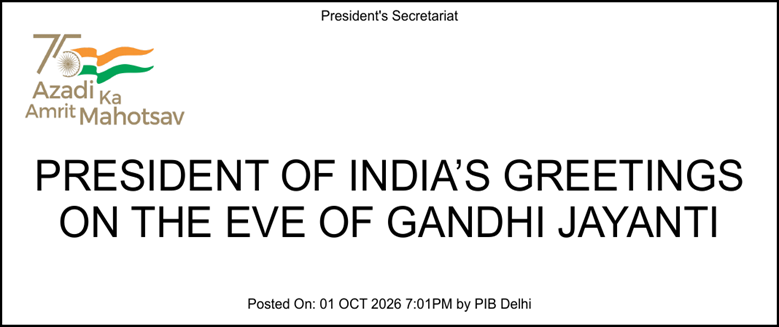
- Recently, the honourable President of India, paid tribute to Mahatma Gandhi in her message on the eve of Gandhi Jayanti (2 October), marking his 157th birth anniversary.
- She highlighted the relevance of Gandhi’s message of peace and non-violence amid global conflict, and linked the goal of Viksit Bharat by 2047 to his ideal of Sarvodaya.
Key Points of the President’s Message
- Global relevance: Gandhiji’s life and ideals are widely respected by the global community, and his message of peace and non-violence is even more relevant amid war and conflict in many parts of the world.
- Sarvodaya: Priority to empathy and inclusion, so that no citizen is deprived of the benefits of development, reflects Gandhi’s ideal of Sarvodaya — the welfare and upliftment of all.
- National goal: India is advancing towards Viksit Bharat by 2047.
- Call to action: Commitment to an empowered, developed and Atmanirbhar Bharat through ethical conduct and active participation.
About Mahatma Gandhi
- Born: 2 October 1869 at Porbandar, Gujarat; full name Mohandas Karamchand Gandhi.
- Titles: ‘Father of the Nation’ was first used by Subhas Chandra Bose in a 1944 radio address; ‘Mahatma’ is popularly credited to Rabindranath Tagore; also called Bapu.
- South Africa phase (1893–1915): Founded the Natal Indian Congress (1894) and Phoenix Settlement (1904); started the journal Indian Opinion (1903); first Satyagraha in 1906 against the Asiatic Law Amendment Ordinance; founded Tolstoy Farm (1910).
- Return to India: 9 January 1915 (observed as Pravasi Bharatiya Diwas); political guru was Gopal Krishna Gokhale; founded Sabarmati Ashram in 1917.
- Writings and journals: Hind Swaraj (1909); autobiography The Story of My Experiments with Truth; journals Young India, Navajivan (1919) and Harijan (1933).
- Congress presidency: Presided over the Belgaum session (1924), the only INC session he presided over.
- Death: Assassinated on 30 January 1948 by Nathuram Godse at Birla House, Delhi.
Concept of Sarvodaya
- Meaning: ‘Welfare/upliftment of all’; the term comes from Gandhi’s Gujarati adaptation of John Ruskin’s Unto This Last (1908).
- Principle: Rejects the utilitarian idea of ‘the greatest good of the greatest number’ and aims at the good of every individual, with no one left behind.
Core Gandhian Principles
- Satya and Ahimsa: Truth and non-violence as the basis of personal and political conduct.
- Satyagraha: Insistence on truth through non-violent resistance.
- Swadeshi: Use of locally made goods, symbolised by Khadi; links to the modern idea of Atmanirbhar Bharat.
- Trusteeship: Wealthy persons to act as trustees of wealth for the benefit of society.
- Constructive Programme: Khadi and village industries, communal harmony and removal of untouchability.
Major Gandhian Movements in India
- Champaran Satyagraha (1917): First Satyagraha in India, against the oppressive Tinkathia system of indigo cultivation.
- Ahmedabad Mill Strike and Kheda Satyagraha (1918): Wage dispute of mill workers (Gandhi’s first hunger strike) and demand for revenue remission by Kheda peasants after crop failure.
- Non-Cooperation Movement (1920–22): Withdrawn after the Chauri Chaura incident (February 1922).
- Civil Disobedience Movement (1930): Began with the Dandi March (12 March 1930) against the salt law.
- Quit India Movement (1942): Launched on 8 August 1942 with the call ‘Do or Die’.
Observances associated with 2nd October
- International Day of Non-Violence: Declared by the UN General Assembly in 2007 on Gandhi’s birth anniversary.
- National holiday: Gandhi Jayanti is one of the three national holidays in India, along with Republic Day and Independence Day.
- Swachh Bharat Diwas: Swachh Bharat Mission was launched on 2 October 2014.
- Shared anniversary: 2 October is also the birth anniversary of Lal Bahadur Shastri.
Conclusion
Mahatma Gandhi’s ideals of non-violence, truth and Sarvodaya continue to guide India’s vision of inclusive development, and his message of peace gains added relevance amid present global conflicts.
| Important CTC from this article for UPSC Prelims – Ideal of ‘Sarvodaya’ |