
Context
- Recently, Iceland has expressed interest in collaborating with India in geothermal energy, Carbon Capture, Utilisation and Storage (CCUS) and carbon-to-stone technologies.
Iceland and Geothermal Energy
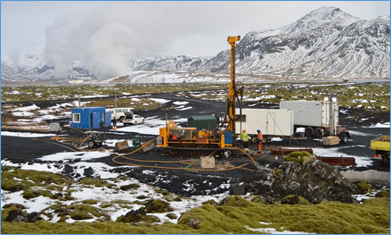
- Iceland has abundant geothermal resources due to its location on the Mid-Atlantic Ridge, where tectonic plates are diverging.
- Around 70% of Iceland’s electricity comes from hydropower and about 30% from geothermal energy.
- Geothermal energy is also widely used for space heating and hot water.
- Iceland has significant expertise in geothermal exploration, power generation and direct heat utilisation.
India’s Geothermal Potential
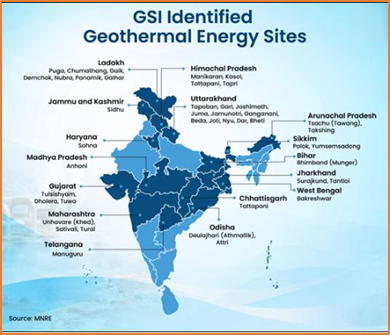
- India has an estimated geothermal potential of about 10.6 GW, according to government estimates.
- Major geothermal regions in India include:
- Himalayan region
- Western India
- Deccan region
- Andaman & Nicobar Islands
- Geothermal energy is a renewable and relatively continuous source of energy, unlike solar and wind, which are weather-dependent.
About CCUS (Carbon Capture, Utilisation and Storage)
- CCUS is a technology that captures CO₂ emissions from industrial sources or directly from the atmosphere.
- The captured CO₂ is either utilised in products/processes or transported and stored permanently in geological formations.
- It can help decarbonise hard-to-abate sectors such as cement, steel, chemicals and refining.
About Carbon-to-Stone Technology
- Carbon-to-Stone is a carbon-removal technology that converts captured CO₂ into stable carbonate minerals (rock) through mineralisation.
- CO₂ reacts with calcium- or magnesium-rich minerals, forming solid carbonates that can store carbon for thousands to millions of years.
- Example: Heirloom Carbon Technologies uses captured CO₂ to accelerate its reaction with limestone-derived materials, permanently storing carbon as solid calcium carbonate.
- Another example: Carbfix injects dissolved CO₂ into basaltic rocks, where it mineralises into stable carbonates.
- Significance: Provides long-term carbon storage and can support net-zero and carbon-removal efforts.
| Important CTC from this article for UPSC India’s Carbon Strategy: CCUS vs. Nature-Based Credits Carbon Capture and Utilisation (CCU) Technologies |
Q. Consider the following statements regarding CCUS and Carbon-to-Stone Technology:
1. CCUS involves capturing CO₂ and either utilising it or storing it in suitable geological formations.
2. In Carbon-to-Stone technology, CO₂ is dissolved in water and injected into basaltic rocks.
3. The injected CO₂ reacts with minerals in basalt to form stable carbonate minerals.

Which of the statements given above is/are correct?
(a) 1 and 2 only
(b) 2 and 3 only
(c) 1 and 3 only
(d) 1, 2 and 3
Answer: (d) 1, 2 and 3

Explanation:
• Statement 1 – Correct: CCUS captures CO₂ and either utilises it in industrial processes or stores it in suitable geological formations.
• Statement 2 – Correct: In the Carbon-to-Stone approach, CO₂ is dissolved in water and injected into basaltic rock formations.
• Statement 3 – Correct: CO₂ reacts with minerals present in basalt and gets converted into stable carbonate minerals, enabling long-term storage as rock.