
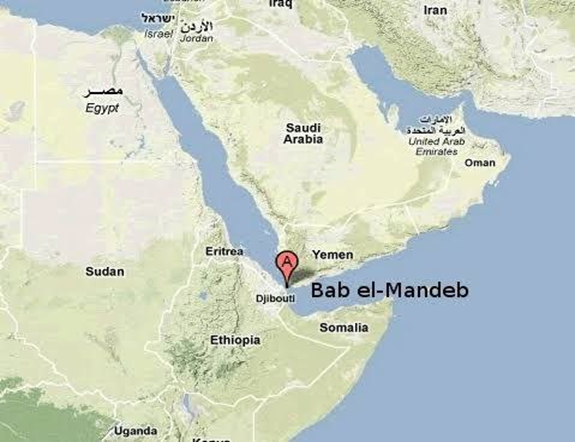
Context
Recently, the Red Sea region has faced a critical escalation as Iran’s central military command (Khatam al-Anbiya) warned it would “completely block” the Bab al-Mandeb Strait and the Strait of Hormuz if the United States continues its naval blockade of Iranian ports.
1. The Red Sea
The Red Sea is a narrow seawater inlet of the Indian Ocean, lying between Africa and the Arabian Peninsula.
- Bordering Countries (Littoral States):
- Eastern Shore: Saudi Arabia, Yemen.
- Western Shore: Egypt, Sudan, Eritrea, Djibouti.
- Northern Extremity: Bordered by the Sinai Peninsula, the Gulf of Aqaba, and the Gulf of Suez (connecting to the Mediterranean via the Suez Canal).
- Physical Characteristics: It is one of the hottest and saltiest bodies of water in the world due to high evaporation rates and low freshwater inflow from rivers.
- Geological Origin: It occupies part of the Great Rift Valley and was formed by the divergence of the Arabian and African tectonic plates.
2. The Bab al-Mandeb Strait
Known as the “Gate of Tears” (Bab al-Mandeb), it is a strategic chokepoint between the Horn of Africa and the Middle East.
- Connection: It connects the Red Sea (Northwest) to the Gulf of Aden and the Arabian Sea (Southeast).
- Bordering Nations: It separates Yemen on the Arabian Peninsula from Djibouti and Eritrea in Africa.
- Key Feature: The strait is divided into two channels by Perim Island (Mayyun Island), which belongs to Yemen. The western channel is wider and deeper, facilitating the movement of large oil tankers.
Strategic and Economic Importance
I. Global Trade Chokepoint
The Red Sea-Suez Canal-Bab al-Mandeb corridor is the shortest maritime route between Europe and Asia. If this passage is blocked, ships must travel an additional 6,000 nautical miles around Africa, increasing transit time by 14 to 20 days.
II. Energy Security
It is a critical transit point for crude oil and Liquefied Natural Gas (LNG) from the Persian Gulf to European and American markets. Any disruption here causes an immediate spike in global Brent crude prices.
III. Importance for India
- Exports: Over 50% of India’s exports to Europe and the US East Coast pass through this route.
- Energy: While India gets much of its oil from Russia and the Gulf via the Strait of Hormuz, the Red Sea remains vital for refined petroleum exports.
- Security: The Indian Navy often conducts “Anti-Piracy” and “Maritime Security Operations” (like Operation Sankalp) in this region to protect Indian-flagged vessels.
Q. Consider the following statements regarding the geography of the Red Sea region:
1.	The Red Sea is connected to the Mediterranean Sea through the Bab al-Mandeb Strait.
2.	Ethiopia is one of the littoral countries that shares a direct coastline with the Red Sea.
3.	The Bab al-Mandeb Strait separates the Arabian Peninsula from the Horn of Africa.

Which of the statements given above is/are correct?
(a) 1 and 2 only
(b) 3 only
(c) 1 and 3 only
(d) 1, 2, and 3

Answer: B) 3 only

Solution:
STATEMENT 1 IS INCORRECT: The Red Sea is connected to the Mediterranean Sea via the Suez Canal (North). The Bab al-Mandeb connects the Red Sea to the Gulf of Aden (South).
STATEMENT 2 IS INCORRECT: Ethiopia is a landlocked country. It lost its Red Sea coastline when Eritrea gained independence in 1993. The littoral countries are Egypt, Sudan, Eritrea, Djibouti, Saudi Arabia, and Yemen.
STATEMENT 3 IS CORRECT: The Bab al-Mandeb Strait acts as a maritime border between Yemen (Arabian Peninsula) and Djibouti/Eritrea (Horn of Africa).