
Context
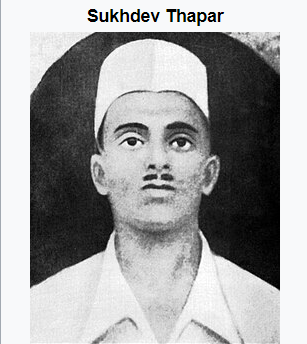
Recently, honorable Home Minister paid tribute to Sukhdev Thapar on his birth anniversary, stating that the immortal revolutionary symbolized indomitable courage, patriotism, and sacrifice, and dedicated his entire life to India’s freedom struggle.
1. Early Life & Background
- Sukhdev Thapar was born on 15 May 1907 in the Naughara area of Old Ludhiana, Punjab. He belonged to a Punjabi Khatri community and was brought up by his uncle Lala Achintram after the death of his father.
- Sukhdev was only twelve years old when his uncle was arrested by the British police for organising an agitation against the Rowlatt Act. The arrest of his uncle again in 1921 during the Non-Cooperation Movement deepened his resentment and determined his path as a revolutionary.
2. Key Revolutionary Contributions
Sukhdev was not just a soldier but a high-level planner for the HSRA.
- Naujawan Bharat Sabha: He was a founding member of this organization (formed in 1926), which aimed to mobilize the youth against British rule and communalism.
- The Saunders Assassination (1928): Following the death of Lala Lajpat Rai due to a brutal lathi charge, the HSRA decided on a retaliatory strike. Sukhdev is credited with being the primary strategist who chose the team and oversaw the logistics for the assassination of John P. Saunders.
- Central Assembly Hall Bombing (April 1929): Sukhdev was also part of the conspiracy to bomb inside the Central Assembly in New Delhi. The HSRA had no interest in causing casualties; they merely wanted to draw public attention to the injustice meted out to Indians by the British.
- Lahore Conspiracy Case:.Three individuals — Hans Raj Vohra, Jai Gopal, and Phanindra Nath Ghosh — turned approvers for the British government, leading to a total of 21 arrests including Sukhdev Thapar and Shivaram Rajguru.
| The 1915 First Lahore Conspiracy Case was a pivotal series of trials held between April and September 1915, targeting members of the Ghadar Party who attempted to incite a pan-Indian mutiny against British rule during World War I. Led by figures like Kartar Singh Sarabha and influenced by Rash Behari Bose, the planned uprising for February 21, 1915, was foiled, leading to 291 convictions, 42 executions, and many life sentences to the Andaman Cellular Jail |
3. The Hunger Strike and Trial
- While in prison, Sukhdev was a leader in the historic hunger strike demanding that Indian prisoners be treated as “political prisoners” rather than common criminals. This strike lasted over 60 days and gained massive public sympathy, effectively using the British court system as a platform to spread revolutionary propaganda.
4. Ideology and Legacy
- Sukhdev read about various world revolutions, including the Russian and French revolutions. He was especially inspired by the Russian revolution and was quite influenced by Lenin’s revolutionary ideas.
- His letter to Mahatma Gandhi, written just prior to his hanging and protesting against Gandhi’s disapproval of revolutionary tactics, throws light on the key ideological divide between the non-violent (Gandhian) and revolutionary schools of thought in the Indian freedom movement
- Execution: Despite widespread national protests and appeals, Sukhdev was hanged in Lahore Central Jail on March 23, 1931, alongside Bhagat Singh and Rajguru. He was only 23 years old.
- Shaheed Diwas: Their execution day is observed annually as Shaheed Diwas (Martyrs’ Day) in India.
5. HRA VS HSRA
| Feature | HRA | HSRA |
| Full Form | Hindustan Republican Association | Hindustan Socialist Republican Association |
| Established | 1924 | 1928 |
| Key Founders | Ram Prasad Bismil, Sachindra Nath Sanyal, Jogesh Chandra Chatterjee | Bhagat Singh, Chandrasekhar Azad, Sukhdev Thapar |
| Main Objective | Armed revolution to overthrow British rule and establish a federal republic | Socialist revolution along with ending British colonial rule |
| Ideology | Republican Nationalism | Socialist Republicanism |
| Major Event | Kakori Train Robbery | Lahore Conspiracy Case and Central Assembly Bombing |
Consider the following statements regarding Sukhdev Thapar:
1. He was a founding member of the Naujawan Bharat Sabha, which aimed to mobilize youth against British rule and communalism.
2. He was executed along with Bhagat Singh and Chandrasekhar Azad in Lahore Central Jail in 1931.
Which of the statements given above is/are correct?
(a) 1 only
(b) 2 only
(c) Both 1 and 2
(d) Neither 1 nor 2
Answer:
(a) 1 only
Explanation:
• Statement 1 is correct: Sukhdev Thapar was a founding member of the Naujawan Bharat Sabha established in 1926.
• Statement 2 is incorrect: Sukhdev was executed along with Bhagat Singh and Shivaram Rajguru, not Chandrashekhar Azad.