
Context
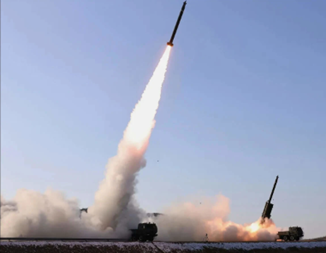
- Recently, an Australian think tank report warned that China’s ability to conduct direct missile strikes on mainland Australia is increasing. The report highlights the deployment of the Dong Feng-27 (DF-27) intermediate-range ballistic missile (IRBM), which could potentially place Australia within China’s strike range, reflecting the evolving strategic balance in the Indo-Pacific region.
Key Highlights of the Report
I. China’s Expanding Missile Reach
- China is rapidly modernizing its missile arsenal under the People’s Liberation Army Rocket Force (PLARF).
- The report suggests that the DF-27 missile can potentially strike targets across mainland Australia from Chinese territory.
- This development signifies a shift in Australia’s security environment, where geographical distance may no longer provide sufficient strategic protection.
II. Why Australia is Concerned
- Australia’s military strategy has traditionally relied on its distance from potential adversaries.
- Long-range missiles and hypersonic technologies are reducing the effectiveness of this geographic advantage.
- The growing missile threat may require Australia to strengthen:
- Missile defence systems,
- Long-range strike capabilities,
- Strategic partnerships such as AUKUS.
DF-27 Missile: Key Facts
I. Classification and Range
- Intermediate-Range Ballistic Missile (IRBM).
- Reportedly capable of carrying both conventional and nuclear warheads.
- Estimated range: 5,000–8,000 km.
- Places several Indo-Pacific targets, including parts of Australia, within reach.
II. Significance
- Considered one of China’s most advanced missile systems.
- May possess hypersonic glide vehicle (HGV) capabilities, making interception more difficult.
- Enhances China’s Anti-Access/Area Denial (A2/AD) strategy.
About Intermediate-Range Ballistic Missiles (IRBMs)
I. Characteristics
- Range between 3,000 km and 5,500 km.
- Trajectory & Speed: Like all ballistic missiles, IRBMs leave the Earth’s atmosphere during their flight and follow a high-arcing, unpowered trajectory toward their target.
- Payloads: They are highly capable strategic weapons, primarily built to carry nuclear warheads, though they can also deliver conventional payloads.
- Designed to strike targets at regional and intercontinental distances.
- Can carry conventional or nuclear payloads.
Examples
| Missile | Country |
| DF series | China |
| Agni-IV | India (often categorized near IRBM range class) |
| Jericho series | Israel |
| Shahab-5, Sejjil | Iran |
Which of the following missile systems are generally categorized under the Intermediate-Range Ballistic Missile (IRBM) class?
1. DF series missiles
2. Agni-IV
3. Jericho series
4. Sejjil missile
Select the correct answer using the code given below:
(a) 1 and 2 only
(b) 1, 2 and 3 only
(c) 2, 3 and 4 only
(d) 1, 2, 3 and 4
Answer: (d) 1, 2, 3 and 4
Explanation
The following missile systems are generally classified as Intermediate-Range Ballistic Missiles (IRBMs) or fall within the IRBM range category (3,000–5,500 km):
1. DF (Dong Feng) series – China
o Several variants such as DF-26 and DF-27 fall within or near the IRBM category.
2. Agni-IV – India
o Range of about 4,000 km, placing it in the IRBM class.
3. Jericho series – Israel
o Certain variants of the Jericho missile family are categorized as IRBMs.
4. Sejjil – Iran
o A solid-fuel ballistic missile often classified in the medium-to-intermediate range category.