
Context
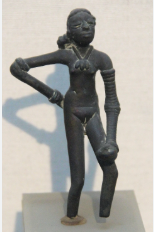
- Recently, the National Council of Educational Research and Training (NCERT) announced that it will restore the original image of the “Dancing Girl” figurine of Mohenjo-daro in its Class 9 Arts textbook Madhurima.
- The decision came after criticism over a modified version of the image in which shading was added to cover the figurine’s bare torso, resulting in a “clothed” appearance.
About the Dancing Girl Figurine
- One of the most iconic artefacts of the Indus Valley Civilization (IVC).
- Discovered from Mohenjo-daro (present-day Sindh, Pakistan).
- Belongs to the Harappan Civilization.
- Estimated age: Around 2500 BCE.
- Material: Bronze.
- Height: Approximately 10.5 cm.
- Prepared using the Lost-Wax Casting Technique.
- Represents the advanced metallurgical skills and artistic excellence of the Harappans.
Distinctive Features
- Depicts a young female figure in a confident posture.
- Left hand placed on the hip.
- Right arm hanging freely.
- Adorned with numerous bangles.
- Considered evidence of developed craftsmanship and cultural sophistication.
Mohenjo-daro: Key Facts
- Meaning: Mohenjo-daro means “Mound of the Dead”.
- Location: Situated on the banks of the Indus River in present-day Sindh Province, Pakistan.
- Discovery: Discovered in 1922 by R. D. Banerji (Rakhal Das Banerji).
Important Structures
- Great Bath, Granary, Assembly Hall, Advanced drainage system, Citadel and Lower Town
UNESCO Status
- Declared a UNESCO World Heritage Site in 1980.
With reference to the “Dancing Girl” figurine of the Indus Valley Civilization, consider the following statements:
1. It was discovered from Mohenjo-daro in present-day Pakistan.
2. The figurine is made of bronze using the Lost-Wax Casting Technique.
3. It belongs to the Mature Harappan period and is dated to around 2500 BCE.
4. It was discovered by Sir John Marshall in 1922.
Which of the statements given above are correct?
(a) 1, 2 and 3 only
(b) 1 and 4 only
(c) 2 and 3 only
(d) 1, 2, 3 and 4
Answer: (a) 1, 2 and 3 only
Explanation:
• Statement 1 is correct: The Dancing Girl was discovered at Mohenjo-daro (Sindh, Pakistan).
• Statement 2 is correct: It is a bronze sculpture made using the Lost-Wax Casting Technique.
• Statement 3 is correct: It belongs to the Harappan Civilization and is dated to around 2500 BCE.
• Statement 4 is incorrect: Mohenjo-daro was discovered in 1922 by R. D. Banerji (Rakhal Das Banerji), not Sir John Marshall.