
Context
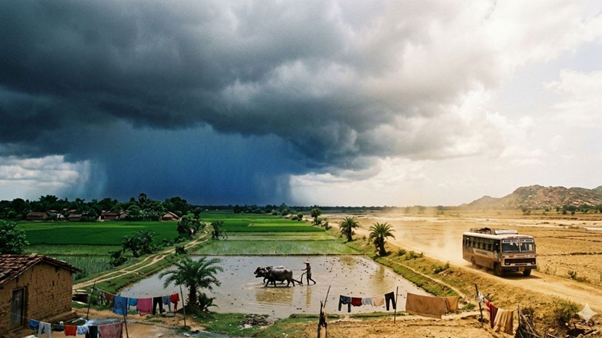
- India is currently facing a 35% nationwide monsoon rainfall deficit, largely due to stalled cloud progression over central and western regions. Consequently, the India Meteorological Department (IMD) has lowered its seasonal forecast to 90% of the Long-Period Average (LPA), signaling the potential impact of a ‘Super El Niño’. This delay has prompted the Union government to initiate crop contingency plans, as agricultural disruptions risk driving up retail food inflation.
Understanding the Monsoon
Basics and Origin
- Etymology: Derived from the Arabic word mausin or the Malayan word monsin, meaning ‘season’.
- Definition: Monsoons are rhythmic, periodic secondary winds characterized by a complete seasonal reversal in direction.
- Mechanism: They function as massive, large-scale convection cells, acting similarly to land and sea breezes. While peculiar to the Indian Subcontinent, they also affect South East Asia and parts of Central Western Africa.
The Dual Monsoon System
| Feature | South-West (SW) Monsoon (Summer) | North-East (NE) Monsoon (Winter) |
| Origin point | Intense low-pressure system over the Tibetan plateau. | High-pressure cells over the Tibetan and Siberian plateaus. |
| Wind Direction | Sea to Land. | Land to Sea. |
| Key Beneficiaries | Most of India, Indonesia, Myanmar, and Bangladesh. | South-eastern Indian coast (Tamil Nadu, South Seemandhra), SE China, Japan. |
Factors Influencing the SW Monsoon
1. Factors Governing Onset:
- Intense summer heating of the Tibetan plateau.
- Presence of a permanent high-pressure cell in the South Indian Ocean (east to north-east of Madagascar).
- Movement of the Subtropical Jet Stream (STJ) and the Tropical Easterly Jet (TEJ).
- Northward migration of the Inter-Tropical Convergence Zone (ITCZ).
2. Factors Governing Intensity:
- Pressure gradients between the Tibetan Low and the South Indian Ocean High.
- Somali Jet (Findlater Jet) and the Somali Current.
- Indian Ocean branch of the Walker Cell and the Indian Ocean Dipole (IOD).
The Role of ITCZ & Coriolis Force
- What is the ITCZ? A low-pressure zone near the equator where South-East (SE) and North-East (NE) trade winds converge, characterized by ascending air and heavy clouds.
- The Summer Shift: As the Sun moves vertically over the Tropic of Cancer, the ITCZ shifts northwards (20°- 25° N) over the Indo-Gangetic Plain, becoming the Monsoon Trough.
- The Coriolis Deflection: The SE trade winds from the southern hemisphere cross the equator. Under the influence of the Coriolis force, they are deflected right, blowing from a south-west to north-east direction, effectively becoming the SW Monsoon.
Core Meteorological Terminologies
- El Niño: A climate pattern characterized by the unusual warming of surface waters in the eastern tropical Pacific Ocean, which disrupts the global Walker Cell circulation and historically suppresses the intensity of the Indian South-West monsoon.
- Somali Jet: A low-level, high-velocity cross-equatorial atmospheric wind current (also called the Findlater Jet) that flows along the coast of East Africa and directly modulates the moisture transport and baseline intensity of the incoming summer monsoon winds over the Arabian Sea.
- Indian Ocean Dipole (IOD): An ocean-atmosphere phenomenon in the Indian Ocean defined by the temperature differential between its western basin (near Africa) and eastern basin (near Indonesia), where a positive phase enhances Indian monsoon rainfall and a negative phase suppresses it
With respect to the Indian Monsoon system, consider the following statements:
I. During the summer season, the Inter-Tropical Convergence Zone (ITCZ) shifts northwards to position itself over the Indo-Gangetic Plain, functioning as the Monsoon Trough.
II. Historical data from previous El Niño years demonstrates a consistent, predictable pattern of severe rainfall deficits specifically during the month of June.
Which of the statements given above is/are correct?
A) I only
B) II only
C) Both I and II
D) Neither I nor II
Answer: A
Explanation:
Statement I is correct: In the summer season, the Inter-Tropical Convergence Zone (ITCZ) shifts northwards to 20°–25° N latitude over the Indo-Gangetic Plain. In this position, it is often called the Monsoon Trough and serves as the zone of maximum rainfall.
Statement II is incorrect: An analysis of June rainfall departures for El Niño years shows no consistent early-season signal. For example, during the strong El Niño of 2015, June rainfall was 14% above normal, whereas severe drought years like 2002 and 2004 recorded near-normal June rainfall, with deficits arriving only in July and later.