
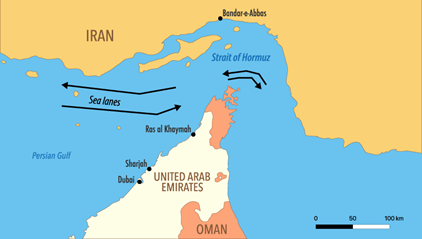
After Reading This Article You Can Solve This UPSC Mains Model Question:
“Examine how Iran’s control over the Strait of Hormuz impacts global energy security. In this context, analyze India’s strategic vulnerabilities and suggest measures to ensure its energy resilience.” 15 Marks (GS-2, International Relations)
Context
Iran’s control over the strategic Strait of Hormuz chokepoint exposes global energy vulnerabilities, turning India’s heavy import reliance into a critical national security risk.
Background of the Crisis
- Historical Precedent: Global superpowers (UK, USA, Japan, China) have historically fused economic prosperity with maritime dominance.
- The Indian Contrast: India’s weak shipping sector reflects a gap in its geopolitical ambitions, despite its seafarers generating billions in foreign exchange under risky conditions (piracy, conflict zones).
The Strait of Hormuz: A Strategic Chokepoint
- Geopolitical Leverage: The recent conflict highlighted that controlling strategic waterways is as consequential as imposing economic sanctions.
- Iran’s Strategic Gains: Despite sustaining heavy military damage from Israel and the US, Iran leveraged the Strait of Hormuz to expose global economic vulnerabilities by disrupting energy flows.
- The New Maritime Order: Iran has announced the creation of the Persian Gulf Strait Authority to act as the sole administrator for transits.
- The Shift: Historically, transit vessels paid no tolls and did not report to Iran/Oman. Under a new MoU, shipping companies must now accept Iran as a decisive stakeholder.
- Quid Pro Quo: The framework envisages lifting sanctions on Iran and its trading vessels in exchange for transit stability.
Challenges for India
The crisis has underscored a major strategic and energy vulnerability for India due to a lack of credible contingency planning.
- Energy Vulnerability: India’s critical fuel and LPG strategies rely heavily on uninterrupted energy imports moving directly through this volatile chokepoint.
- Inadequate Cavern Storage: The country lacks sufficient long-term underground strategic reserves and cavern storage to handle sudden, extended supply disruptions.
- Commercial Shipping Deficit: India suffers from a weak domestic shipping sector and a limited fleet of Indian-flagged carriers, leaving it heavily dependent on foreign vessels during global crises.
- Strategic Vulnerability: The absence of a robust, credible maritime contingency plan exposes India’s economic lifeline to unexpected regional blockades.
- Geopolitical Policy Missteps: India diluted its own bypass options by underutilizing and losing momentum on critical alternative routes like Iran’s Chabahar Port.
- New Transit Hegemony: India must now navigate a rewritten maritime order where shipping lines are forced to comply with Iran’s newly formed Persian Gulf Strait Authority for transits.
Global Responses: The Shift to “Zero-Dependency”
- Nations worldwide are actively reassessing their reliance on the Strait of Hormuz.
- Example: The UAE is aggressively pursuing a “Zero Hormuz Dependency” strategy by investing heavily in alternative land corridors and pipeline infrastructure that bypass the chokepoint.
Way Forward
To safeguard its strategic and economic interests, India must pivot from passive dependence to active strategic autonomy:
- Diversification of Supply Chains: Reduce over-reliance on a single geographic chokepoint for LPG and crude oil sourcing.
- Infrastructure Resilience: Invest heavily in long-term underground cavern storage to buffer against sudden maritime blockades.
- Reviving Alternate Corridors: Re-engage with and accelerate alternative maritime and land corridors (e.g., maximizing the potential of Chabahar, INSTC, or India-Middle East-Europe Economic Corridor equivalents).
- Strengthening the Shipping Sector: Build a robust, Indian-flagged commercial fleet to ensure trade security during global conflicts.
- Strategic Partnerships: Deepen maritime diplomacy and administration talks with regional players like Oman and other Gulf states.
Conclusion
For India, reducing dependence on the Strait of Hormuz is no longer just an economic goal, it has graduated into an absolute strategic necessity for national security.