
Context:
The Archaeological Survey of India (ASI) has officially transferred human skeletal remains excavated from Rakhigarhi to the Anthropological Survey of India (AnSI). This collaboration aims to conduct advanced DNA and scientific studies to understand the ancestry, environment, and lifestyle of the Indus Valley Civilization.
Location and Status
- Geography: Located in Hisar district, Haryana, along the dried Ghaggar-Hakra (Sarasvati) river plain.
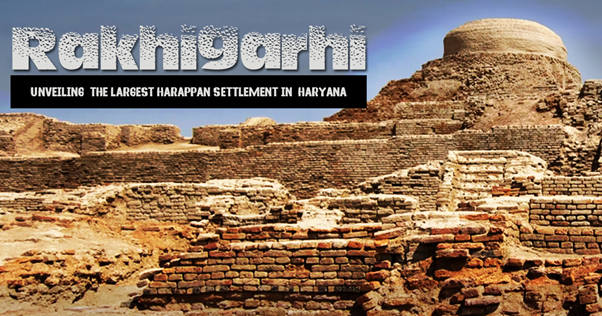
- Largest Settlement: Spreading across 550 hectares, it is officially recognized as the largest known settlement of the Harappan Civilization, surpassing Mohenjodaro, Harappa, and Dholavira.
- Chronology: The site shows continuous habitation across three stages: the Early, Mature (2600–1900 BCE), and Late Harappan periods.
DNA Findings and Ancestry
- Mound 7 Discoveries: Excavations at this dedicated burial plot yielded 56 skeletons, including a highly preserved 4,600-year-old female skeleton.
- Indigenous Origin: Genomic analysis of these remains revealed a complete absence of the “steppe pastoral” (Indo-Aryan) gene and ancient Iranian farmer ancestry. This crucial finding refutes earlier migration theories and points to a distinct, indigenous origin for the Harappan people.
Urban Architecture and Economy
- Town Planning: The settlement features mud and burnt-brick houses with highly efficient drainage and sanitation systems.
- Class Divisions: Excavations at Mound 3 revealed an aristocratic settlement with prominent burnt-brick structures.
- The Granary: A prominent mud-brick granary with seven rectangular chambers and traces of decomposed grains was discovered.
- Trade and Lapidary: A flourishing trade economy is evident from the discovery of steatite beads, standardized weights, fish hooks, and a rich “toy culture”.
Rituals and Artefacts
- Ceremonial Practices: Evidence of complex rituals includes the discovery of triangular fire altars and designated areas indicating animal sacrifices.
- Unique Seals: A notable discovery is a seal depicting an alligator symbol accompanied by five Harappan letters.
Heritage Development
- Global Museum: Following an MoU signed in 2022, Rakhigarhi is being developed to host the world’s largest museum dedicated exclusively to Harappan culture.
- Endangered Status: In 2012, the Global Heritage Fund recognized Rakhigarhi as one of the ten most endangered heritage sites in Asia.
With respect to the archaeological site of Rakhigarhi, consider the following statements:
I. It is the largest known settlement of the Indus Valley Civilization, located in the Ghaggar-Hakra river plain.
II. Recent DNA analysis of skeletal remains from the site confirmed the presence of the steppe pastoral gene among the Harappan people.
 III. The site features evidence of triangular fire altars and a seal depicting an alligator symbol.
Which of the statements given above is/are correct?
 (a) I and II only
(b) II and III only
(c) I and III only
(d) I, II, and III
Answer: C
Explanation:
Statement I is correct: Rakhigarhi, located in Hisar, Haryana, along the Ghaggar-Hakra river plain, is officially the largest known settlement of the Harappan civilization, surpassing sites like Mohenjodaro and Harappa.
Statement II is incorrect: Genomic analysis of the skeletal remains revealed the absence of the "steppe pastoral" gene and ancient Iranian farmer ancestry, pointing to a distinct, indigenous origin rather than confirming an external migration.
Statement III is correct: Archaeological excavations at the site have uncovered distinct ceremonial practices, including triangular fire altars, and a unique seal depicting an alligator symbol.