
Context
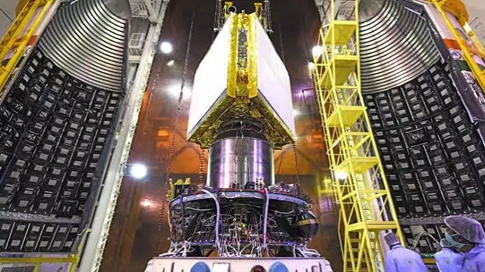
Recently, the Indian Space Research Organisation (ISRO) has successfully carried out the ground static test of the Polar Satellite Launch Vehicle’s (PSLV) third stage (PS3) at the Static Test Facility in the Satish Dhawan Space Centre, Sriharikota.
About Polar Satellite Launch Vehicle (PSLV)
- Developed by: Indian Space Research Organisation (ISRO).
- Nature: A four-stage, expendable launch vehicle designed primarily to place satellites into polar, sun-synchronous and other Earth orbits.
- First Successful Launch: 1994.
- Nickname: ISRO’s workhorse launch vehicle.
- Payload Capability: Can launch satellites into multiple orbits, including Sun-Synchronous Polar Orbit (SSPO), Geosynchronous Transfer Orbit (GTO) and Low Earth Orbit (LEO).
About the Four Stages of PSLV
- First Stage (PS1): Uses solid propellant and is assisted by six strap-on solid rocket boosters in standard configurations.
- Second Stage (PS2): Uses liquid propellant, with the Vikas engine.
- Third Stage (PS3): Uses solid propellant and provides additional thrust to accelerate the launch vehicle.
- Fourth Stage (PS4): Uses liquid propellant and provides the final orbital injection of satellites.
About the Third Stage (PS3)
- Nature: A solid-propellant rocket stage.
- Function: Provides the required thrust to accelerate the launch vehicle after the second-stage separation.
- Importance: Plays a critical role in the vehicle’s overall flight performance and orbital insertion sequence.
What is a Ground Static Test?
- It involves testing a rocket stage while it is held stationary on a test stand.
- The test evaluates the performance of the propulsion system and its components under controlled conditions.
- It helps assess whether the stage performs according to its design specifications before flight.
Significance of PSLV
- Satellite Launches: Supports the launch of Indian and foreign satellites.
- Earth Observation: Enables the placement of remote-sensing satellites into Sun-Synchronous Polar Orbits.
- Multi-Satellite Capability: Has demonstrated the capability to deploy multiple satellites in a single mission.
- Space Research: Supports scientific and interplanetary missions.
| Important CTC from this Article: Satish Dhawan Space Centre (SDSC) |