
Context
A recent study published in the journal Nature found that the Amazon rainforest has become a net carbon source rather than a carbon sink.
What is a Carbon Sink and Carbon Source?
- Carbon Sink: A natural or artificial system that absorbs more carbon dioxide from the atmosphere than it releases.
- Examples: Forests, oceans and soils.
- Carbon Source: A system that releases more carbon dioxide into the atmosphere than it absorbs.
- Examples: Burning fossil fuels, forest fires and deforestation.
About the Amazon Rainforest
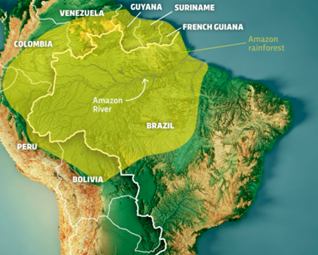
- Location: The Amazon Basin is located in South America, close to the Equator, between approximately 10°N and 10°S. It represents an equatorial climatic region.
- River System: The Amazon River originates in the Andes Mountains in the west and flows eastwards into the Atlantic Ocean. Numerous tributaries join it, forming the world’s largest river basin by area.
- Countries Covered: The Amazon River Basin extends across Brazil, Peru, Bolivia, Ecuador, Colombia and parts of Venezuela. The wider Amazon biome also extends into Guyana, Suriname and French Guiana.
- Climate: The basin experiences a hot, humid and wet equatorial climate throughout the year. Rainfall occurs almost daily, and day and night durations remain nearly equal.
- Natural Vegetation: The dense evergreen tropical rainforests are known as Selvas. They have tall trees, overlapping branches and dense canopies that restrict sunlight from reaching the forest floor.
- Important Plant Species: Ebony, rosewood, mahogany, rubber and cinchona are important trees found in the Amazon rainforest. Lianas (woody climbers) are also characteristic of these forests.
- Wildlife: The Amazon is exceptionally rich in biodiversity. Important animals include jaguars, sloths, monkeys, tapirs, pumas, alligators, anacondas and piranhas.
- Indigenous Tribes associated with Amazon: Munduruku, Yanomami and Tikuna.
- Carbon Storage: According to a 2026 study published in Nature, the Amazon rainforest stores approximately 123 ± 23 billion tonnes of carbon in vegetation and soils.
- Moisture Recycling: Through evapotranspiration, Amazonian forests release water vapour into the atmosphere. This moisture recycling contributes up to half of the region’s precipitation.
Key Findings of the Nature Study
- Methodology: Scientists measured atmospheric CO₂ concentrations at different altitudes using research aircraft across four Amazonian locations.
- Major Finding: The Amazon has become a net carbon source rather than a carbon sink.
- Carbon Emissions: Wildfires caused the Amazon to release approximately 1.17 billion metric tonnes more carbon than it absorbed.
- Rainfall Decline: Precipitation declined by 17% during the peak dry-season period (August–October) between 1979 and 2018.
Human Activities Behind Amazon Degradation
| Human Activity | Change (2010–2024) |
| Mining area | Increased by 272% |
| Pasture area | Increased by 19% |
| Soybean plantations | Expanded by 193% |
Impact of Forest Loss on Climate
- Forest loss reduces precipitation, raises temperatures and lengthens the dry season, delaying the onset of the wet season.
- Precipitation: Fell by 17% during the dry-season peak (August–October) from 1979 to 2018.
- Temperature: Annual temperature rose by 0.9°C during the same period.
Q. Consider the following statements with reference to mining activities in the Amazon region:

1. Gold mining in the Amazon is largely associated with small-scale artisanal mining, locally known as garimpo.
2. The Carajás Mineral Province in Brazil is an important region for the extraction of industrial and critical minerals.
3. Mining activities affect less than 10% of Indigenous lands across the Amazon region.
4. Mercury pollution from artisanal gold mining can contaminate rivers and enter aquatic food chains.

Which of the statements given above are correct?

(a) 1, 2 and 3 only
(b) 1, 2 and 4 only
(c) 2, 3 and 4 only
(d) 1, 2, 3 and 4

Answer: (b) 1, 2 and 4 only

Explanation:
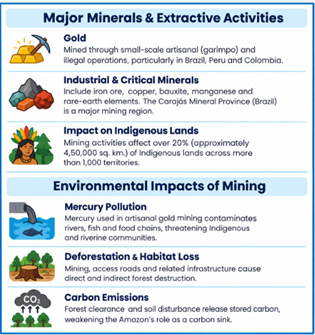
• Statement 1 is Correct: Gold is mined through small-scale artisanal operations, known as garimpo, as well as illegal mining networks, particularly in Brazil, Peru and Colombia.
• Statement 2 is Correct: The Carajás Mineral Province in Brazil is a major mining region associated with iron ore and other industrial minerals.
• Statement 3 is Incorrect: Mining activities affect over 20% of Indigenous lands, covering approximately 4,50,000 sq. km. across more than 1,000 territories.
• Statement 4 is Correct: Mercury used in artisanal gold mining contaminates rivers, fish and aquatic food chains, threatening Indigenous and riverine communities.