
Context
Recently, the Assam government has formally banned unauthorized recreational and commercial drone operations near identified Amur falcon congregation and roosting sites.
About Amur Falcon (Falco amurensis)
- Taxonomic Profile: A long-distance migratory raptor belonging to the falcon family (Falconidae).
- Alternative Nomenclature: Widely recognized as the Eastern Red-footed Falcon, Eastern Red-footed Kestrel, Manchurian Falcon, and Red-legged Falcon.
- Habitat Preferences: Thrives across diverse landscapes, including open forests, grasslands, wetlands, and agricultural terrain.
- Taxonomic Profile: A small migratory bird of prey belonging to the falcon family (Falconidae).
- Nomenclature: Named after the Amur River region of eastern Russia and northeastern China, where it breeds.
- Migration: Undertakes one of the longest overwater migrations among raptors.
Morphological Features
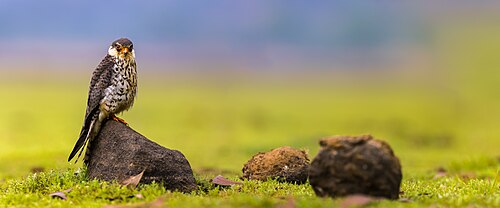
- Sexual Dimorphism: Males and females exhibit distinctly different plumage patterns.
- Male Traits: Characterized by a dark, sooty-grey body with brownish-red thighs and vent, contrasted by a prominent white underwing lining visible in flight.
- Female Traits: Features a darker grey back paired with a white chest and vent heavily patterned with dark chevron spots.
- Shared Characteristics: Both sexes display bright orange eye-rings, feet, and beak bases (the cere).
- Predatory Adaptations: Combines exceptional speed and strength with highly acute eyesight to detect prey mid-flight or from vast distances.
Global Distribution
- Breeding Grounds: The species breeds extensively in southeastern Siberia and Northern China.
- Wintering Grounds: Undertakes a massive, flock-based, trans-continental migration to spend the winter across Southern and East Africa.
Amur Falcons in India
- Crucial Midway Halts: The northeastern states, specifically Nagaland, Manipur, Arunachal Pradesh, and parts of Assam, serve as critical transit and resting grounds during their annual cross-hemisphere migration.
- Local Cultural Significance: The raptor is locally revered and known as Kahuaipuina in Nagaland and Manipur.
- Key Roosting Hub: The Doyang Reservoir in Pangti Village, Nagaland, is a globally famous roosting site and stands as a highly successful community-led conservation model.
- Global Recognition: Owing to these massive seasonal congregations, Nagaland has earned the prestigious title of the “Falcon Capital of the World”.
- The Oceanic Crossing: After staging in India, the flocks undertake a grueling 3,000 km non-stop flight over the Arabian Sea without resting to reach the African continent.
Threats & Conservation Status
- Primary Threats: Highly vulnerable to illegal hunting during migration, severe habitat loss at roosting sites, and disruptions from changing weather patterns.
- IUCN Red List: Least Concern (LC).
- Wildlife (Protection) Act, 1972: Accorded strict statutory protection under Schedule IV.
| Important CTC from this Article: IUCN RED LIST |
Q. With reference to the Amur falcon (Falco amurensis), consider the following statements:

1. It is an annual trans-continental migratory raptor that breeds in southeastern Siberia and northern China and winters in Southern Africa.
2. Unlike many raptor species, both the male and female Amur falcons possess identical sooty-grey plumage with no sexual dimorphism.
3. In India, the species receives statutory protection under the provisions of the Wildlife (Protection) Act, 1972.

How many of the statements given above are correct?

(a) Only one
(b) Only two
(c) All three
(d) None

Answer: (b) Only two

Explanation:
• Statement 1 is correct: The Amur falcon breeds across southeastern Siberia and northern China, passes through northeast India as a staging passage migrant, and completes an epic migration across the Indian Ocean to winter in Southern and East Africa.
• Statement 2 is incorrect: The Amur falcon exhibits marked sexual dimorphism. The male has dark sooty-grey plumage with reddish thighs, orange orbital rings/feet, and striking white underwing linings, whereas the female has a darker grey back and a white underside heavily patterned with dark spots.
• Statement 3 is correct: The Amur falcon is legally protected in India under the Wildlife (Protection) Act, 1972, which prohibits hunting, capturing, trapping, and unauthorized disturbance of the birds and their habitats.