
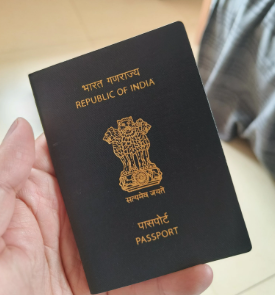
Context
- A senior official from the Ministry of External Affairs (MEA) recently clarified that the Indian passport is strictly a “travel document” and not a “citizenship document.” This clarification emerged during the 14th Passport Seva Divas, responding to queries on whether a passport could be used to challenge exclusions from the voter list during Special Intensive Revisions (SIR) of electoral rolls.
Passport: Purpose and Legal Status
- A passport is issued under the Passports Act, 1967.
- It facilitates:
- International travel.
- Identification of the holder abroad.
- Consular assistance from Indian missions.
- It is not equivalent to a citizenship certificate.
Why Passport is Not Proof of Citizenship?
- Passport issuance involves verification of identity and nationality but is not intended to conclusively establish citizenship status.
- Citizenship determination is governed by:
- Citizenship Act, 1955
- Relevant rules and government records.
- Citizenship can be established through multiple documents and legal processes, whereas a passport primarily enables travel.
About Passport Seva Divas
- Date: Marked annually on June 24.
- E-Passports: Currently, around 10% of Indian passport holders possess an e-passport, which features a chip-based secure document system designed to make international travel seamless.
- Network Coverage: There are 545 Passport Seva Kendras (PSKs) across India, practically covering almost every Lok Sabha constituency to ease service delivery.
- Support Framework: One-stop centres have been setup to support distressed Indian women in the diaspora, notably in Gulf countries and Singapore.
About e-Passports
- Embedded electronic chip storing biometric and personal data.
- Enhanced security against forgery and tampering.
- Faster immigration clearance.
- Compliant with international standards of the International Civil Aviation Organization (ICAO).
Citizenship: Constitutional & Legal Provisions
- Constitutional Provisions: Articles 5–11 deal with citizenship at the commencement of the Constitution and empower Parliament to regulate citizenship matters.
- Citizenship Act, 1955: Modes of Acquiring Citizenship:
- By Birth
- By Descent
- By Registration
- By Naturalization
- By Incorporation of Territory
- Modes of Losing Citizenship:
- Renunciation
- Termination
- Deprivation
With reference to the Indian Passport, consider the following statements:
1. An Indian passport is conclusive proof of Indian citizenship.
2. Passports in India are issued under the Passports Act, 1967.
3. e-Passports contain an embedded electronic chip storing the holder's data.
Which of the statements given above is/are correct?
(a) 1 and 2 only
(b) 2 and 3 only
(c) 1 and 3 only
(d) 1, 2 and 3
Answer: A
Explanation: B
•  Statement 1 is incorrect: The Ministry of External Affairs (MEA) and various Indian courts (such as the Bombay High Court) have explicitly clarified that an Indian passport is primarily a travel and transit document to facilitate international movement. It is not conclusive proof of citizenship. In fact, under Section 20 of the Passports Act, 1967, the Central Government possesses the statutory authority to issue a passport or travel document to a non-citizen under specific circumstances. Consequently, the mere possession of a passport does not definitively establish absolute citizenship.
•  Statement 2 is correct: Passports, travel documents, and emergency certificates in India are regulated and issued under the legal framework provided by the Passports Act, 1967.
•  Statement 3 is correct: India's upgraded e-Passports feature an embedded electronic microprocessor chip (typically utilizing Radio Frequency Identification or RFID technology) alongside an antenna. This chip securely stores the passport holder's demographic particulars, digital signature, and biometric data (such as fingerprints and facial recognition) to safeguard against forgery and streamline global immigration clearance.