
Context
- The National Payments Corporation of India (NPCI) plans to expand the scope of the BHIM (Bharat Interface for Money) UPI platform by offering financial products such as credit cards, loans, investments, and insurance through the BHIM app. This initiative aims to improve financial inclusion and provide easier access to financial services.
Key Highlights
Expansion of BHIM Services
- BHIM will move beyond digital payments to become a broader financial services platform.
- Planned offerings include:
- Credit Cards
- Loans
- Investment Products
- Insurance Services
Role of NPCI BHIM Services Ltd. (NBSL)
- NBSL, a subsidiary of NPCI, will collaborate with:
- Banks
- Non-Banking Financial Companies (NBFCs)
- Insurance providers
- The objective is to distribute financial products through a unified digital platform.
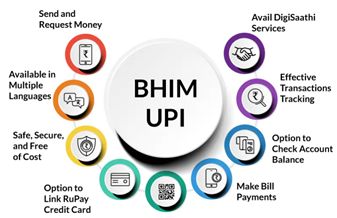
About BHIM UPI
It is UPI based payment interface that allows real time fund transfers using a single identity like your mobile number or name.
| Feature | Details |
| Full Form | Bharat Interface for Money (BHIM) |
| Launched | December 2016 |
| Developed By | National Payments Corporation of India (NPCI) |
| Parent Ministry | Ministry of Electronics and Information Technology (MeitY) |
| Based On | Unified Payments Interface (UPI) |
| Regulatory body | While MeitY handles the government framework, the underlying financial network (UPI) is regulated by the Reserve Bank of India (RBI). |
| Is BHIM A Wallet? | BHIM is not a wallet. It is a payments application that allows users to make instant bank transfers. |
| In How Many Languages Is BHIM Available? | Currently it is available in 20 languages. |
| Does BHIM run without internet? | Yes. You can dial *99# to avail offline features of BHIM, on any mobile phone. |
| Countries Accepting BHIM / UPI | UPI is now live in over eight countries, including the UAE, Singapore, Bhutan, Nepal, Sri Lanka, France, Mauritius and Qatar, positioning India as a global leader in digital payments. |
What is UPI?
- Unified Payments Interface (UPI) is a real-time payment system developed by NPCI.
- It enables:
- Instant bank-to-bank transfers.
- Interoperable digital payments.
- 24×7 fund transfers.
- Regulated by the Reserve Bank of India (RBI).
Key Features
- Virtual Payment Address (VPA).
- QR-code-based payments.
- Interoperability across banks.
- Instant settlement.
Consider the following statements regarding BHIM and UPI:
1. BHIM is developed and operated by the Reserve Bank of India.
2. UPI enables real-time bank-to-bank fund transfers.
3. NPCI is the organization responsible for developing UPI.
Which of the statements given above is/are correct?
(a) 1 only
(b) 2 and 3 only
(c) 1 and 2 only
(d) 1, 2 and 3
The correct answer is (b) 2 and 3 only.
Detailed Explanation:
• Statement 1 is incorrect: BHIM (Bharat Interface for Money) was developed and is operated by the National Payments Corporation of India (NPCI), not the Reserve Bank of India (RBI).
• Statement 2 is correct: The core utility of the Unified Payments Interface (UPI) architecture is to enable instant, real-time, 24/7 bank-to-bank fund transfers directly through a mobile platform.
• Statement 3 is correct: NPCI is an umbrella organization for operating retail payments and settlement systems in India, and it is the primary entity responsible for designing, developing, and launching the UPI ecosystem.