
Context
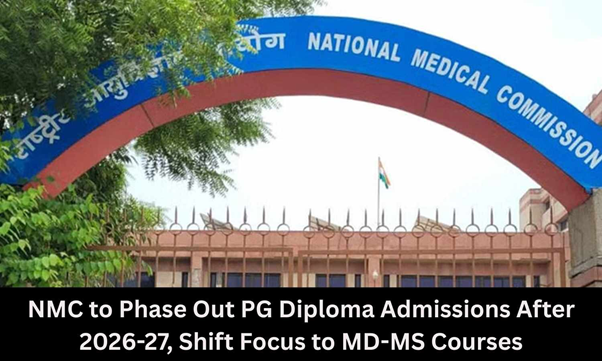
The National Medical Commission (NMC) has ordered the gradual discontinuation of two-year postgraduate medical diploma courses by the academic year 2026-27. Starting in 2027-28, specialist medical training across India will be exclusively conducted through three-year MD (Doctor of Medicine) and MS (Master of Surgery) degree programs.
What is the Transition Timeline?
- Final Admissions: The 2026-27 academic session will be the last year to admit students into traditional postgraduate diploma courses.
- Exclusive Degree Training: From 2027-28 onwards, medical colleges will strictly offer specialist training through MD and MS degree programs.
- Seat Conversion: Medical institutions are mandated to convert their existing diploma seats into equivalent degree seats.
- Nodal Authority: Colleges must apply for this conversion through the Medical Assessment and Rating Board (MARB), an autonomous board under the NMC.
Why is the NMC Phasing Out Diplomas?
- Standardization: To create a uniform and standardized framework for postgraduate medical education across the country.
- Quality Enhancement: To improve the overall quality, depth, and recognition of specialist medical training.
- Modern Alignment: To align Indian medical qualifications with current, contemporary educational standards.
- Resource Optimization: To ensure better and more efficient utilization of existing infrastructure within medical colleges.
How do Diplomas and Degrees Differ?
- Duration: Traditional diplomas (such as those in ENT, ophthalmology, dermatology, tuberculosis, and public health) are typically two-year programs, whereas MD and MS degrees require three years of comprehensive training.
- Historical Role: Diplomas have traditionally provided a quicker educational route, playing a crucial role in rapidly supplying specialist doctors to smaller towns and district-level hospitals.
What is the Potential Rural Health Impact?
- Supply Concerns: The shift to exclusively three-year degree programs raises concerns about the future availability of medical specialists in rural areas.
- Policy Challenge: Health experts are evaluating whether the conversion to MD/MS will successfully elevate medical quality without simultaneously creating a deficit of specialists outside major urban centers.
With respect to the regulatory framework of medical education in India, consider the following statements:
I. The National Medical Commission (NMC) operates as a statutory body that utilizes the Medical Assessment and Rating Board (MARB) to authorize the conversion of existing medical diploma seats into degree seats.
II. The mandated transition from two-year medical diplomas to three-year degree programmes is primarily intended to provide a quicker educational route for deploying specialists in rural health facilities.
Which of the statements given above is/are correct?
(a) I only
 (b) II only
(c) Both I and II
(d) Neither I nor II
Answer: A
Explanation:
Statement I is correct: The National Medical Commission (NMC) is a statutory body that regulates medical education through four autonomous boards. The Medical Assessment and Rating Board (MARB) specifically handles institutional assessments, course permissions, and the mandatory conversion of diploma seats to degree seats.
Statement II is incorrect: The transition to three-year MD/MS degree programmes is strictly aimed at standardizing the quality of specialist training. Historically, it was the traditional two-year diplomas that provided a quicker route to specialist training and played a crucial role in rapidly supplying doctors to smaller towns and rural district hospitals.