
Context
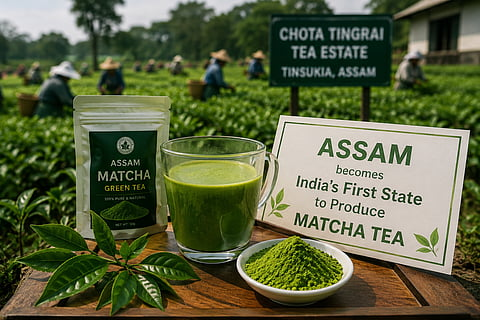
- An Assam-based tea estate has successfully auctioned India’s first batch of commercially produced Matcha tea. This marks a significant milestone in India’s agricultural diversification, bridging traditional Assam tea cultivation heritage with fully automated, state-of-the-art Japanese manufacturing expertise.
What is Matcha and How is it Cultivated?
- Source Plant: Derived from the exact same plant as regular tea, Camellia sinensis.
- Shade-Grown Technique: The tea leaves are intentionally shaded to block 90% of sunlight for 3 to 4 weeks prior to harvesting.
- Chemical Alteration: This shading process drastically boosts chlorophyll and amino acid levels, imparting a distinct vibrant green color and unique flavor.
- Processing: Harvested leaves are finely ground into a vibrant green powder rather than being processed into traditional loose leaves.
- Method of Consumption: Unlike conventional green tea where leaves are steeped and discarded, matcha powder is whisked directly into water and consumed entirely.
- Nutritional Profile: It yields significantly higher concentrations of natural antioxidants, amino acids, and caffeine compared to regular green tea.
Historical Evolution of Indian Tea
- 1823 (Discovery): Robert Bruce discovered wild Camellia sinensis plants in the Upper Brahmaputra Valley of Assam.
- 1833 (Monopoly Ends): The Charter Act ended the British East India Company’s trade monopoly with China, prompting a shift toward domestic Indian production.
- 1834 (Institutional Push): A dedicated Tea Committee was established under Governor-General William Bentinck.
- 1838 (First Export): The first batch of Indian tea from Assam was successfully sent to the United Kingdom for public sale.
Types of Tea Produced in India
India produces diverse tea varieties, differentiated primarily by their processing methods and levels of oxidation:
- Black Tea: The most widely produced, consumed, and exported tea variety in India, fully oxidized to develop a strong flavor.
- CTC (Crush, Tear, Curl) Tea: Machine-processed to create uniform pellets; heavily utilized for mass domestic consumption and standard tea bags.
- Orthodox Tea: Handcrafted using traditional processing methods; renowned for its superior quality, complex flavor profiles, and targeted primarily at export markets.
- Green Tea: Minimally processed and unoxidized to retain high natural antioxidant levels; witnessing rising domestic demand due to health awareness.
- Oolong Tea: A partially oxidized tea, possessing characteristics of both green and black teas; produced in small volumes specifically for niche markets.
- White Tea: The least processed of all varieties, made exclusively from young, unopened tea buds; highly rare, delicate, and produced in severely restricted quantities.
Climatic & Geographical Requirements
Tea is a highly climate-sensitive crop that thrives in tropical and sub-tropical regions.
- Temperature: Optimal growth requires a range of 15°C to 23°C.
- Rainfall: Requires 150–300 cm of annual rainfall, which must be evenly distributed throughout the year.
- Sunlight: Needs a warm, humid climate with at least 5 hours of daily sunlight.
- Soil Parameters: Thrives in slightly acidic, calcium-free soil with a porous sub-soil.
- Topography: Sloping terrain is strictly mandatory to ensure proper water drainage, as water stagnation destroys the roots.
Major Producing Regions & Global Standing
- Leading States: Assam (largest producer; encompasses Assam Valley and Cachar), West Bengal (Darjeeling, Dooars, Terai), and Tamil Nadu (Nilgiri Hills).
- Minor Producers: Kerala, Karnataka, and Himachal Pradesh (specifically the Kangra Valley, renowned for green teas).
- Global Rank: India is the second-largest producer and consumer of tea globally, and the third-largest exporter (trailing Kenya, which exports almost its entire yield, and China).
| About the Tea Board of India Statutory Status: Established as a statutory body under the Tea Act, 1953. Nodal Ministry: Functions under the Ministry of Commerce. Headquarters: Located in Kolkata, with major overseas offices in Dubai and Moscow. Composition: Reconstituted every three years, it comprises 31 members representing producers, traders, governments, and plantation workers. Core Functions: It controls quality certification, promotes exports, provides financial assistance, and protects the global identity of Indian teas. |
With respect to tea cultivation and regulation in India, consider the following statements:
I. Matcha tea is uniquely produced by exposing the Camellia sinensis leaves to continuous, direct sunlight for several weeks prior to harvesting to maximize chlorophyll levels.
II. The Tea Board of India is a statutory organization that functions under the administrative control of the Ministry of Commerce.
III. The optimal geographical conditions for tea cultivation include slightly acidic, calcium-free soil and a sloping terrain to ensure continuous water drainage.
How many of the statements given above are correct?
(a) Only one
(b) Only two
(c) All three
(d) None
Answer: B
Explanation:
Statement I is incorrect: Matcha is cultivated using a specialized shade-grown technique where the tea leaves are intentionally shaded to block 90% of sunlight for 3 to 4 weeks prior to harvesting. This shading, rather than sunlight exposure, is what drastically boosts chlorophyll and amino acid levels.
Statement II is correct: The Tea Board of India is a statutory body established under the Tea Act of 1953, and it operates directly under the Ministry of Commerce to regulate and promote the tea industry.
Statement III is correct: Tea is a highly climate-sensitive crop that strictly requires slightly acidic, calcium-free soil. Furthermore, a sloping terrain is mandatory to ensure proper water drainage, as water stagnation destroys the root system of the plant.