
GS Prelims- Economy/International Relations/ GS Mains – Paper II & III (International Relations, Agriculture, Environment)
Context
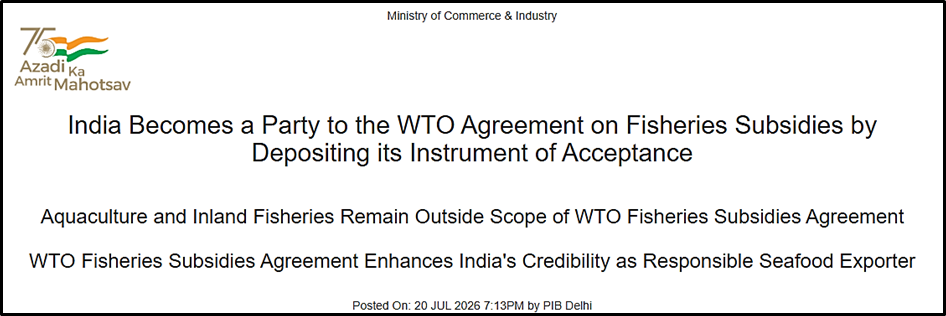
- India deposited its Instrument of Acceptance of the WTO Agreement on Fisheries Subsidies (AFS) on 20 July 2026, formally becoming a Party to the Agreement.
- The instrument was handed over by Commerce Secretary Shri Rajesh Agrawal to the Director-General of the WTO; India is the 123rd WTO Member to deposit its acceptance.
Key Highlights
- Adopted at 12th WTO Ministerial Conference, Geneva, June 2022 – WTO’s first environment-focused agreement.
- Came into force 15 September 2025, after 2/3rd of members accepted it.
- Bans subsidies for illegal (IUU) fishing and overfished stocks; curbs support to big industrial fishing fleets.
- Covers only marine wild-capture fishing; aquaculture & inland fisheries excluded – good for India’s shrimp exports.
- Boosts India’s image as a responsible seafood exporter, helping access to premium markets.
Key Provisions of India’s Domestic Fisheries Framework Supporting Implementation
- Sustainable Harnessing of Fisheries in the Exclusive Economic Zone (EEZ) Rules, 2025.
- Guidelines for Sustainable Harnessing of Fisheries in the High Seas by Indian-Flagged Fishing Vessels, 2025.
- Capacity-building support under the Pradhan Mantri Matsya Sampada Yojana (PMMSY).
- Agreement provides flexibilities for developing and least-developed country Members.
About the World Trade Organization (WTO)
- An intergovernmental organization regulating international trade, headquartered in Geneva, Switzerland.
- Established on 1 January 1995 under the Marrakesh Agreement, succeeding the General Agreement on Tariffs and Trade (GATT).
- Functions on the principle of consensus-based decision-making among member states.
About the Pradhan Mantri Matsya Sampada Yojana (PMMSY)
- A flagship scheme of the Department of Fisheries, Ministry of Fisheries, Animal Husbandry and Dairying, aimed at sustainable and responsible development of the fisheries sector in India.
- Seeks to enhance fish production and productivity, modernise the value chain, and double fishers’/fish farmers’ incomes.
India’s acceptance of the WTO Agreement on Fisheries Subsidies aligns its domestic fisheries governance – spanning the EEZ Rules, 2025, High Seas Guidelines, 2025, and PMMSY – with a binding multilateral environmental-trade framework, while the Agreement’s exclusion of aquaculture and inland fisheries preserves policy space for India’s predominantly small-scale, shrimp-led seafood export sector.