
Important for UPSC Prelims: Government Schemes | Social Justice
Context
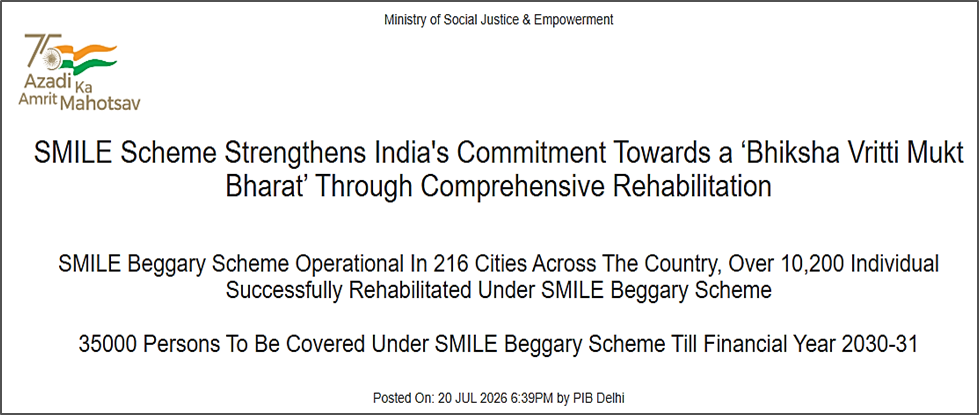
- The Ministry of Social Justice and Empowerment (MoSJE) announced that the SMILE Beggary Scheme is operational in 216 cities, with over 10,200 persons rehabilitated.
- The scheme targets 295 cities and the rehabilitation of 35,000 persons by FY 2030–31, supporting the vision of a ‘Bhiksha Vritti Mukt Bharat’.
About the SMILE Scheme
- Full Form: Support for Marginalized Individuals for Livelihood and Enterprise (SMILE).
- Ministry: Ministry of Social Justice and Empowerment (MoSJE).
- Type: Central Sector Scheme.
- Objective: To ensure the social and economic rehabilitation of vulnerable communities through dignity, inclusion and sustainable livelihood opportunities.
- Background: Introduced by merging the existing schemes for the rehabilitation of persons engaged in begging and the welfare of transgender persons under a common umbrella framework.
- Implementation: The scheme follows a convergence-based approach, involving the Central Government, State Governments, Union Territories, District Administrations, Urban Local Bodies (ULBs), Municipal Corporations, NGOs, Community-Based Organisations (CBOs) and other implementing agencies.
Key Features
- Shelter Homes: Uses existing State/UT and ULB shelter homes; establishes dedicated shelters where needed.
- Comprehensive Rehabilitation: Provides medical care, counselling, documentation, education, skill development and livelihood support.
- Digital Monitoring: The SMILE-Beggary National Portal enables registration, monitoring and tracking of rehabilitation centres.
- Capacity Building: Strengthened through revised operational guidelines and training of implementing agencies.
Key Achievements & Targets
- Operational in: 216 cities.
- Target Coverage: 295 cities by FY 2030–31.
- Persons Rehabilitated: Over 10,200.
- Rehabilitation Target: 35,000 persons by FY 2030–31.
- Priority Areas: Metropolitan cities, religious places, tourist destinations and historical places.
Conclusion
The SMILE Scheme promotes a rehabilitation-centric approach by enabling the social and economic reintegration of vulnerable individuals, supporting the vision of a ‘Bhiksha Vritti Mukt Bharat’.