
Important for UPSC Prelims: Economy
What is Gross Domestic Product (GDP)?
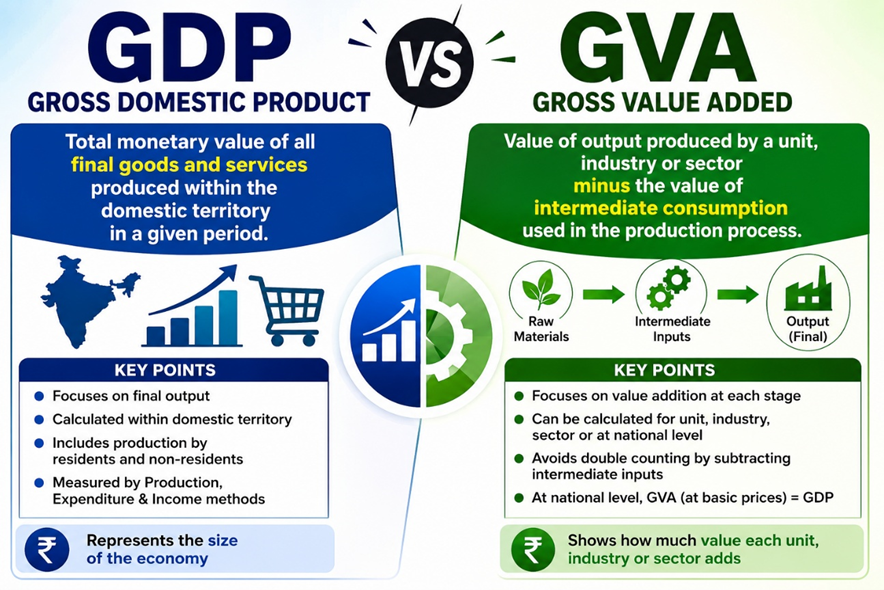
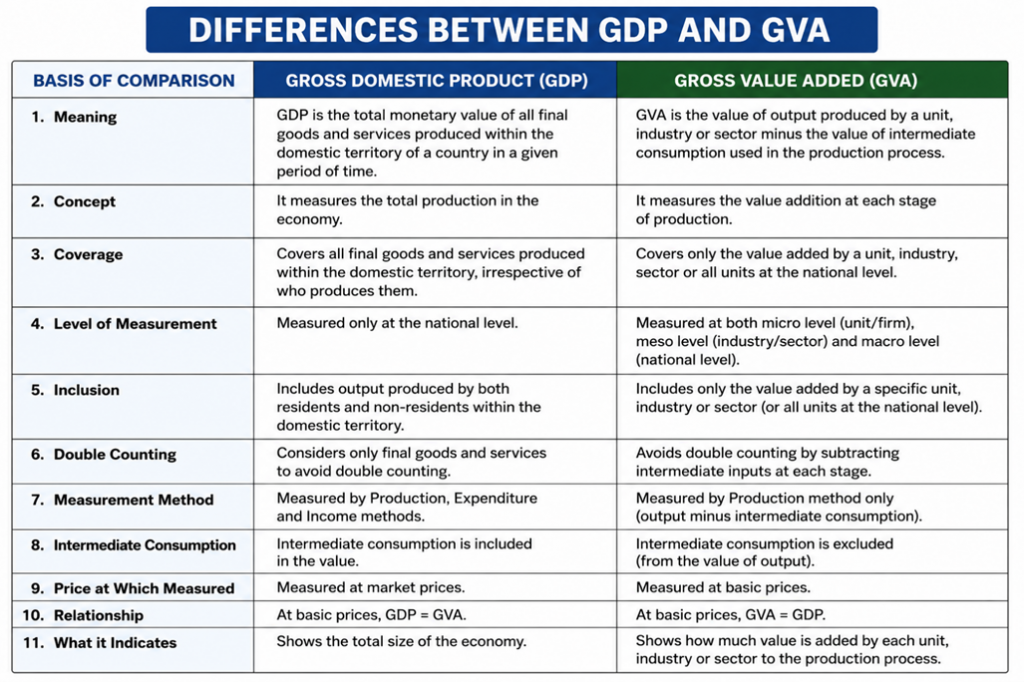
Gross Domestic Product (GDP) is the total monetary value of all final goods and services produced within the domestic territory of a country during a specific period, usually a financial year. It is the most widely used indicator to measure the size and growth of an economy.
- Compiled & Released by: National Statistics Office (NSO), Ministry of Statistics and Programme Implementation (MoSPI).
- Current Base Year: 2022–23.
| Domestic Territory For GDP estimation, Domestic Territory includes: Political boundaries and territorial waters. Embassies and Consulates located abroad. Ships, aircraft and fishing vessels operated by residents. Offshore installations (e.g., oil rigs) operated by residents. |
Key Features of GDP
- Measures the value of final goods and services produced within a country’s domestic territory.
- Calculated at Market Prices (includes product taxes and excludes product subsidies).
- Acts as a demand-side indicator of the economy.
- Used to measure economic growth and compare economic performance across countries.
Types of GDP
1. Nominal GDP
- Measures production at current market prices.
- Reflects changes in both output and prices (inflation).
2. Real GDP
- Measures production at constant prices of the base year.
- Eliminates the effect of inflation and reflects actual economic growth.
Methods of GDP Calculation
GDP is estimated using three methods:
1. Income Method
- Measures the total income earned by factors of production (labour and capital).
- GDP = GDP at Factor Cost + Product Taxes − Product Subsidies
2. Expenditure Method
- Measures total expenditure on final goods and services.
- GDP = C + I + G + (X − M)
- C = Consumption Expenditure
- I = Investment Expenditure
- G = Government Expenditure
- X − M = Net Exports (Exports − Imports)
3. Production (Output) Method
- Measures the total value of goods and services produced (value added) within the economy.
- GDP = Real GDP (at Constant Prices) − Product Taxes + Product Subsidies
What is Gross Value Added (GVA)?
- Gross Value Added (GVA) measures the value added by each producer, industry or sector after deducting the value of intermediate inputs used in production.
- GVA = Value of Output − Intermediate Consumption
- Calculated at Basic Prices.
- Indicates the actual contribution of agriculture, industry, and services to the economy.
- Considered the best measure of the supply-side performance of the economy.
Conclusion
Together, they are the two most important macroeconomic indicators for analysing India’s economic performance and are frequently tested in UPSC Prelims.
| These terms have been mentioned in the following article India Updates the Index of Core Industries (ICI) Series |