
GS Prelims- Modern Indian History
Context
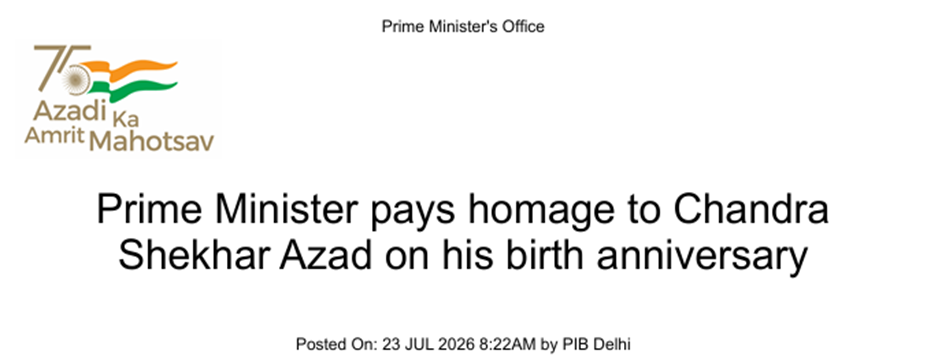
PM Narendra Modi paid tributes to Lokmanya Bal Gangadhar Tilak and paid homage to Chandra Shekhar Azad on their respective birth anniversaries, both falling on the same date.
Key Highlights
- Both leaders were born on 23 July, in 1856 and 1906 respectively — exactly 50 years apart.
- Both figures are commonly tested together with associated organisations, publications, slogans, and places of death/imprisonment.Tribute to Lokmanya Tilak.
About Lokmanya Tilak
- Born 23 July 1856 in Ratnagiri; earned the title “Lokmanya” (accepted by the people) and was called by the British the “Father of Indian Unrest.”
- Leader of the Extremist (“Garam Dal”) wing of the Indian National Congress, part of the “Lal-Bal-Pal” trio with Lala Lajpat Rai and Bipin Chandra Pal; central to the Congress Split at Surat (1907).
- Founded “Kesari” (Marathi) and “Mahratta” (English) newspapers; gave the slogan “Swaraj is my birthright, and I shall have it.”
- Started Ganesh Chaturthi (1893) and Shivaji Jayanti (1895) as public festivals to unite Indians and build mass nationalist consciousness.
- Founded the All India Home Rule League (1916); wrote “Gita Rahasya” while imprisoned in Mandalay Jail, Burma; died on 1 August 1920.
About Chandrasekhar Azad
- Born 23 July 1906 in Bhavra village (present-day Madhya Pradesh); original name Chandrashekhar Tiwari, adopted “Azad” (free) after being flogged as a teenager during the Non-Cooperation Movement (1921).
- Key member of the Hindustan Republican Association (HRA), later reorganised as the Hindustan Socialist Republican Association (HSRA) in 1928, with Bhagat Singh driving its socialist ideological shift.
- Involved in the Kakori Conspiracy (1925) and the assassination of J.P. Saunders, Lahore (1928), carried out in retaliation for the death of Lala Lajpat Rai during the Simon Commission protests.
- Served as a mentor to Bhagat Singh, Rajguru, and Sukhdev, and other HSRA revolutionaries.
- Died on 27 February 1931 at Alfred Park, Allahabad (now Chandrashekhar Azad Park) in a gun battle with police — shot himself to keep his vow of never being captured alive.
Conclusion
Together, this reflect the Prime Minister’s Office’s continuing practice of publicly commemorating freedom fighters’ birth anniversaries through official statements and social media, reinforcing themes of nationalism, service, and cultural pride under the broader Azadi Ka Amrit Mahotsav initiative.
| Important CTC from this article for UPSC Chandra Sekhar Azad Lokmanya Tilak |