
Important for GS Prelims — Science & Technology / Economy
About Data Centres
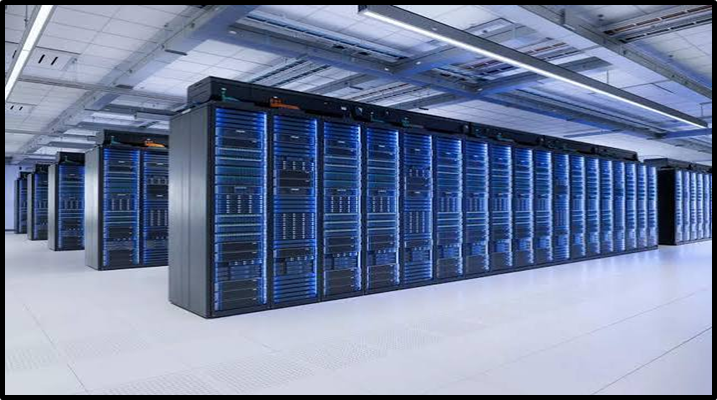
- Data Centres are secure facility housing computing/networking equipment to store, process, and distribute large-scale data — a “computing factory.”
- It’s Core subsystems include IT Infrastructure (servers, networking), Power Systems (UPS, generators), Cooling (chillers, liquid cooling).
- Types of Data Centres- Hyperscale Data Centre, Colocation Data Centre, Cloud Data Centre and Edge Data Centre.
Key Facts about Data Centres
| Particular | Details |
| India’s operational co-location capacity (2025) | ~1.5 GW (1,500 MW) |
| Projected capacity (2030) | 4 GW to 6.5–7 GW |
| Capacity per million internet users (India vs. world average) | 1.2 MW vs. 5 MW |
| Total operational data centres in India | 271 |
| Top 5 metro hubs’ share of India’s DC capacity | ~65% |
| India AI Mission allocation | ₹10,372 crore |
The Sectoral Landscape of Data Centres and Emerging Trends
- Types by role:
- Hyperscale Data Centre — tech giants /AI platforms;
- Colocation Data Centre — leased space, self-managed servers;
- Cloud Data Centre — AWS (Amazon Web Services), Azure, Google Cloud;
- Edge Data Centre — near data source, low latency.
- Largest Hub: Mumbai—46 data centres, ~49% of national capacity, 14+ submarine cable landings.
- Other Hubs: Delhi NCR (38), Chennai (33), Bengaluru (31), Hyderabad (28).
- NIC National Data Centres: Hyderabad (2008), Pune (2010), Delhi (2011), Bhubaneswar (2018); host the MeghRaj Cloud (2014).
- AI Transition: Rack density exceeds 30 kW; liquid/immersion cooling is replacing air cooling beyond 15 kW.
- Budget 2026–27: Tax holiday till 2047 for foreign cloud and AI data centre providers.
Policy, Regulatory Framework & Digital India
- The Infrastructure status of 2022 enables long-term low-cost financing, external commercial borrowings for DC operators; also scales Digital India’s digital public infrastructure goal.
- The Digital India Mission (2015) treats digital infrastructure as a “core utility”; data centres form its physical backbone for e-governance and digital service delivery.
- MeghRaj Government of India Cloud (GI Cloud) (official name for the MeghRaj initiative) — runs from National Informatics Centre – National Data Centre, powers e-governance rollout under Digital India.
- Localization mandates (RBI 2018, Digital Personal Data Protection Act, 2023) — align with Digital India’s digital sovereignty push, mandating on-soil data storage.
- IndiaAI Mission (₹10,372 crore) — extends Digital India via subsidised GPU access, edge nodes, foundational model hubs.
- Ministry of Electronics and Information Technology — sets Power Usage Effectiveness (PUE) <1.35 benchmark for AI cloud infrastructure tenders in India.
Conclusion
Data centres integrate IT, power, and cooling subsystems, classified into hyperscale, colocation, cloud, and edge types. India holds a low global capacity share despite high data generation, with capacity concentrated in five metro hubs and shaped by 2022 infrastructure status, localization mandates, and AI-driven cooling shifts.
| This CTC has been elaborately explained in India’s Data Centre Capacity to Touch 12 GW by 2030 |