
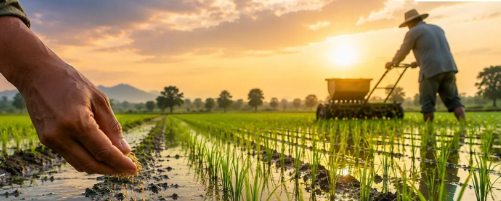
About Direct-Seeded Rice (DSR)
- Definition: Direct-Seeded Rice (DSR) is a method of rice cultivation in which seeds are directly sown into the field instead of raising seedlings in a nursery and transplanting them into puddled fields. It reduces labour requirements, water consumption and cultivation costs.
- Nature: A resource-efficient method of rice cultivation.
- Principle: Direct sowing of rice seeds without conventional transplanting.
- Objective: Conserve water, reduce labour requirements and improve resource-use efficiency.
- Application: Practised under both rainfed and irrigated conditions, depending on the production system.
- Alternative Name: Non-puddled or direct-sowing method of rice cultivation.
Major Features and Characteristics
- Direct Sowing: Seeds are sown directly into the main field using broadcasting or seed drills.
- Water Conservation: Avoids the need for nursery raising, puddling and continuous flooding during crop establishment.
- Labour Efficiency: Reduces labour requirements associated with transplanting.
- Cost Reduction: Can lower cultivation costs through savings in labour, water and fuel.
- Timely Sowing: Allows faster crop establishment and may facilitate timely harvesting.
- Mechanisation: Supports the use of seed drills and other farm machinery.
Methods of Direct-Seeded Rice
DSR is broadly practised through three methods:
- Dry Seeding: Dry seeds are sown in dry soil under suitable moisture conditions.
- Wet Seeding: Pre-germinated seeds are sown in wet, puddled or saturated soil.
- Water Seeding: Pre-germinated seeds are broadcast directly into standing water.
Environmental Significance
- Groundwater Conservation: Reduces water requirements compared with conventional transplanted rice systems.
- Climate Change Mitigation: Can reduce methane emissions by avoiding prolonged flooded conditions.
- Energy Savings: Reduces energy consumption associated with pumping and puddling.
- Soil Health: Avoids repeated puddling, helping reduce soil disturbance.
- Sustainable Agriculture: Promotes efficient utilisation of natural resources.
Challenges and Limitations
- Weed Management: Greater weed infestation can occur because fields are not continuously flooded.
- Water Management: Requires proper moisture management during crop establishment.
- Crop Establishment: Uneven seed distribution and moisture conditions may affect germination.
- Technical Requirements: Requires suitable machinery, improved varieties and farmer training.
- Yield Variability: Productivity depends on soil conditions, climate, weed control and management practices.
DSR vs Traditional Transplanting
| Parameter | DSR | Traditional Method |
| Seed establishment | Direct sowing | Nursery and transplanting |
| Puddling | Generally avoided | Usually practised |
| Water requirement | Generally lower | Generally higher |
| Labour requirement | Lower | Higher |
| Weed management | More challenging | Relatively easier under flooding |
Conclusion
Direct-Seeded Rice is a resource-efficient alternative to conventional transplanted rice cultivation. By reducing water and labour requirements and potentially lowering methane emissions, it supports sustainable and climate-resilient rice production.
| This concept has been mentioned in the following article: Reshaping India’s Rice Economy for Sustainable Growth |