
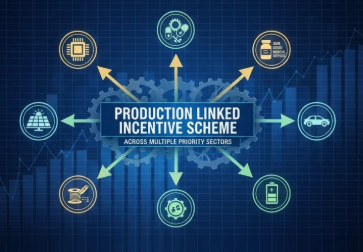
About the Production Linked Incentive (PLI) Scheme
- Launch: Introduced in 2020 as part of the Government’s efforts to strengthen domestic manufacturing under the vision of Atmanirbhar Bharat.
- Nature: A Central Sector Scheme that provides financial incentives to eligible manufacturers based on incremental production or sales of goods manufactured in India.
- Nodal Department: Department for Promotion of Industry and Internal Trade (DPIIT), Ministry of Commerce and Industry, coordinates and monitors the overall PLI framework.
- Coverage: Initially introduced in selected sectors and subsequently expanded to cover 14 strategic sectors.
- Objective: Strengthen domestic manufacturing capabilities, attract investments, enhance exports, generate employment and improve India’s global competitiveness.
14 Strategic Sectors Covered under the PLI Scheme
The PLI Scheme covers the following 14 sectors:
| Sector | Major Areas Covered |
| 1. Mobile Manufacturing | Mobile phones and specified electronic components |
| 2. Critical Key Starting Materials (KSMs), Drug Intermediates (DIs) and APIs | Bulk drugs and pharmaceutical raw materials |
| 3. Medical Devices | Domestic manufacturing of medical equipment |
| 4. Automobiles and Auto Components | Automobile manufacturing and components |
| 5. Pharmaceuticals | Pharmaceutical drugs |
| 6. Specialty Steel | Value-added specialty steel products |
| 7. Telecom and Networking Products | Telecom equipment and networking products |
| 8. Electronic/Technology Products | Specified electronic and technology products |
| 9. White Goods | Air conditioners and LED products |
| 10. Food Products | Processed food products |
| 11. Textile Products | Man-made fibre (MMF) segments and technical textiles |
| 12. High-Efficiency Solar PV Modules | Domestic solar photovoltaic module manufacturing |
| 13. Advanced Chemistry Cell (ACC) Batteries | Advanced battery manufacturing |
| 14. Drones and Drone Components | Domestic drone and component manufacturing |
Implementation and Monitoring
- Overall Coordination: DPIIT is responsible for the overall coordination and monitoring of the PLI framework.
- Sectoral Implementation: Respective administrative ministries and departments implement individual PLI schemes.
- Eligibility: Companies must satisfy sector-specific investment, production and incremental sales criteria.
- Incentive Disbursement: Incentives are released upon fulfilment of prescribed performance conditions under the respective scheme guidelines.
Conclusion
The Production Linked Incentive Scheme is an important industrial policy initiative aimed at transforming India into a globally competitive manufacturing hub. By linking financial incentives with incremental production, the scheme seeks to attract investments, promote domestic value addition, strengthen exports and advance the vision of Atmanirbhar Bharat.
| This concept has been mentioned in the following article: Impact Assessment of Production Linked Incentive (PLI) Schemes |