
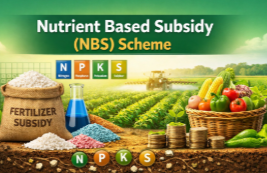
About the Nutrient-Based Subsidy (NBS) Scheme
- Launch: Introduced with effect from 1 April 2010 by the Government of India.
- Ministry: Ministry of Chemicals and Fertilizers.
- Implementing Department: Department of Fertilizers.
- Nature: A Central Sector Scheme that provides subsidies on Phosphatic and Potassic (P&K) fertilizers based on their nutrient content.
- Coverage: Initially covered 25 grades of P&K fertilizers. From Kharif 2024, three additional grades were included, increasing the coverage to 28 grades.
- Beneficiaries: Farmers receive the benefit through the availability of fertilizers at subsidized prices.
- Objective: Promote balanced fertilizer application, ensure affordable availability of fertilizers and improve soil health and agricultural productivity.
Major Features and Characteristics
- Nutrient-Based Subsidy: Provides a fixed subsidy per kilogram of nutrients contained in eligible fertilizers rather than a uniform subsidy per bag.
- Nutrient Coverage: Subsidy is linked to four major nutrients:
- Nitrogen (N)
- Phosphorus (P)
- Potassium (K)
- Sulphur (S)
- Fixed Subsidy Rates: The government determines nutrient-wise subsidy rates, which are revised periodically, generally on a seasonal basis.
- Decontrolled Pricing: Manufacturers and importers are allowed to determine the Maximum Retail Price (MRP) of P&K fertilizers, subject to government monitoring and reasonable pricing guidelines.
- Subsidy Disbursement: Subsidy is provided to eligible fertilizer manufacturers and importers to ensure the availability of fertilizers to farmers at affordable prices.
- Balanced Fertilization: Encourages the appropriate use of different nutrients and reduces excessive dependence on particular fertilizers.
- Additional Subsidy: Provides additional incentives for specified P&K fertilizers fortified or coated with micronutrients such as Boron and Zinc.
- Seasonal Revision: Subsidy rates are reviewed in light of changes in international fertilizer and input prices.
Fertilizers Covered under the NBS Scheme
The scheme covers 28 grades of Phosphatic and Potassic (P&K) fertilizers, including:
| Fertilizer | Full Form |
| DAP | Di-Ammonium Phosphate |
| MOP | Muriate of Potash |
| SSP | Single Super Phosphate |
| NPK | Nitrogen, Phosphorus and Potassium |
| NPS | Nitrogen, Phosphorus and Sulphur |
| NPKS | Nitrogen, Phosphorus, Potassium and Sulphur |
| MAP | Mono-Ammonium Phosphate |
| TSP | Triple Super Phosphate |
Difference between NBS and Urea Subsidy
| Nutrient-Based Subsidy (NBS) | Urea Subsidy |
| Applicable to P&K fertilizers. | Applicable to urea. |
| Subsidy is linked to nutrient content. | Subsidy is provided under a separate government-controlled pricing mechanism. |
| Fertilizer companies can determine MRP subject to government oversight. | Government regulates the MRP of urea. |
| Introduced in 2010. | Operates under a separate fertilizer subsidy framework. |
Important: Urea is not covered under the NBS Scheme.
Conclusion
The Nutrient-Based Subsidy Scheme is an important agricultural policy intervention aimed at promoting balanced fertilizer consumption and improving soil health. By linking subsidies to the nutrient composition of fertilizers, it seeks to ensure affordable fertilizer availability, enhance agricultural productivity and promote sustainable agriculture in India.
| This concept has been mentioned in the following article: Nutrient-Based Subsidy (NBS) Scheme |