
Important for GS Prelims: Environment
Background
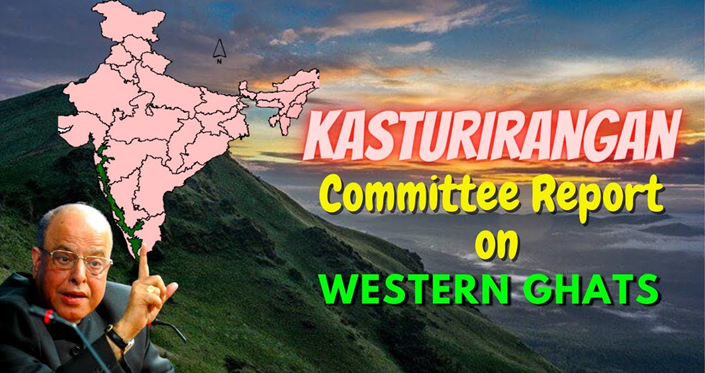
- Constituted by the Ministry of Environment & Forests (MoEF) in 2012 under Dr. K. Kasturirangan.
- Formed to review the recommendations of the Madhav Gadgil Committee (WGEEP) after objections from the six Western Ghats states. (Gujarat, Maharashtra, Goa, Karnataka, Kerala, Tamil Nadu).
Objective
- To recommend a balanced approach between ecological conservation and sustainable development in the Western Ghats.
- To identify Ecologically Sensitive Areas (ESAs) using scientific methods such as remote sensing and geospatial mapping.
Key Recommendations
- Recommended 37% of the Western Ghats (about 60,000 sq. km) as Ecologically Sensitive Area (ESA).
- Proposed protection mainly for natural landscapes while excluding most cultural landscapes (human settlements, plantations and agricultural lands).
- Recommended a complete ban in ESA on:
- Mining and quarrying
- Thermal power plants
- Red-category (highly polluting) industries
- Stressed that major infrastructure projects should undergo strict Environmental Impact Assessment (EIA) before approval.
- Promoted sustainable agriculture, eco-tourism, and conservation of biodiversity.
Difference from Madhav Gadgil Committee
| Madhav Gadgil Committee | Kasturirangan Committee |
| Recommended about 64% of Western Ghats as Ecologically Sensitive Zone (ESZ). | Recommended only 37% as Ecologically Sensitive Area (ESA). |
| Favoured stricter conservation with greater local governance. | Favoured a balanced approach combining conservation with development. |
| Included many human-use landscapes. | Excluded most agricultural and plantation areas from ESA. |
Conclusion
The Kasturirangan Committee sought to balance environmental conservation with sustainable development by protecting the ecologically significant natural landscapes of the Western Ghats.
| This concept has been elaborately discussed in the following article: Centre Reissues Draft Notification on Western Ghats Eco-Sensitive Area (ESA) |