
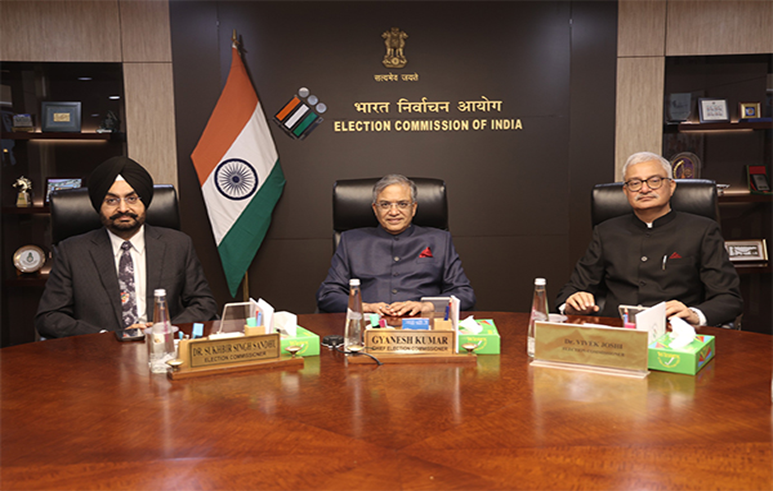
Important for UPSC Prelims: Polity
About Chief Election Commissioner (CEC)
- The office of the Chief Election Commissioner (CEC) is established under Article 324 of the Constitution of India.
- The Election Commission of India (ECI) is an independent constitutional body entrusted with the superintendence, direction and control of elections in the country.
Functions
The Election Commission conducts elections to:
- Parliament (Lok Sabha and Rajya Sabha)
- State Legislatures
- Office of the President
- Office of the Vice-President
Composition
- The Election Commission consists of the Chief Election Commissioner (CEC) and such number of Election Commissioners (ECs) as the President may determine.
- While all Commissioners enjoy equal decision-making powers, the CEC functions as the Chairperson of the Commission.
Appointment
- The President of India appoints the CEC and other Election Commissioners under Article 324(2).
- Their appointment is governed by the Chief Election Commissioner and Other Election Commissioners (Appointment, Conditions of Service and Term of Office) Act, 2023.
Tenure and Independence
- The CEC holds office for six years or until attaining the age of 65 years, whichever is earlier.
- The salary and service conditions of the CEC are charged on the Consolidated Fund of India, ensuring financial independence from the Executive.
Removal
- Chief Election Commissioner
The CEC can be removed only in the same manner and on the same grounds as a Judge of the Supreme Court, namely proved misbehaviour or incapacity.
- Election Commissioners
Other Election Commissioners can be removed by the President only on the recommendation of the CEC, providing an additional safeguard for the Commission’s independence.
Removal Process of the CEC
- A removal motion must be signed by 100 Lok Sabha Members or 50 Rajya Sabha Members.
- The Speaker or Chairman decides whether to admit the motion.
- If admitted, a three-member inquiry committee examines the allegations.
- The motion must be passed by a Special Majority in both Houses of Parliament.
- The President issues the final order of removal after parliamentary approval.
Why are these Safeguards Important?
- They protect the independence and impartiality of the Election Commission.
- They prevent arbitrary removal by the Executive.
- They strengthen the credibility of India’s free and fair electoral process.
Conclusion
- A free and fair electoral process is the cornerstone of a vibrant democracy. The constitutional safeguards provided to the Chief Election Commissioner help preserve the autonomy of the Election Commission and reinforce public confidence in the conduct of elections.
| This concept has been mentioned in the following article Centre Defends CEC & EC Selection Panel Without CJI |