
Context
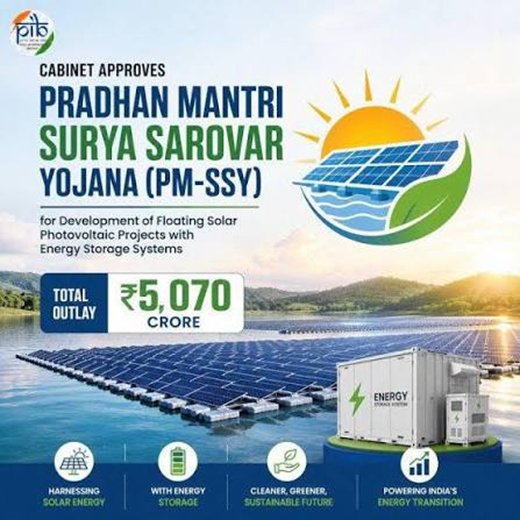
The Union Cabinet has approved the National Floating Solar Mission (NFSM) with a total outlay of ₹5,070 crores to promote floating solar power projects on reservoirs and other water bodies. The mission will provide Central Financial Assistance (CFA) of up to ₹1 crore per MW and aims to achieve 5,000 MW (5 GW) of floating solar capacity by 2030–31.
National Floating Solar Mission (NFSM)
- A Central Sector Scheme to promote the installation of floating solar photovoltaic (FPV) plants on reservoirs, dams, lakes, and other water bodies.
- Designed to diversify India’s renewable energy portfolio while minimizing land-use conflicts.
- Key Features
- Total Outlay: ₹5,070 crore
- Target Capacity: 5,000 MW by 2030–31
- Financial Assistance: Up to ₹1 crore per MW
- Eligible Sites: Reservoirs, dams, lakes, irrigation tanks, and other suitable inland water bodies.
- Implementation: Solar Energy Corporation of India (SECI) and other designated agencies in coordination with States.
What are Floating Solar Plants?
- Floating Solar Photovoltaic (FPV) systems are solar panels mounted on floating structures that are anchored on the surface of water bodies instead of being installed on land.
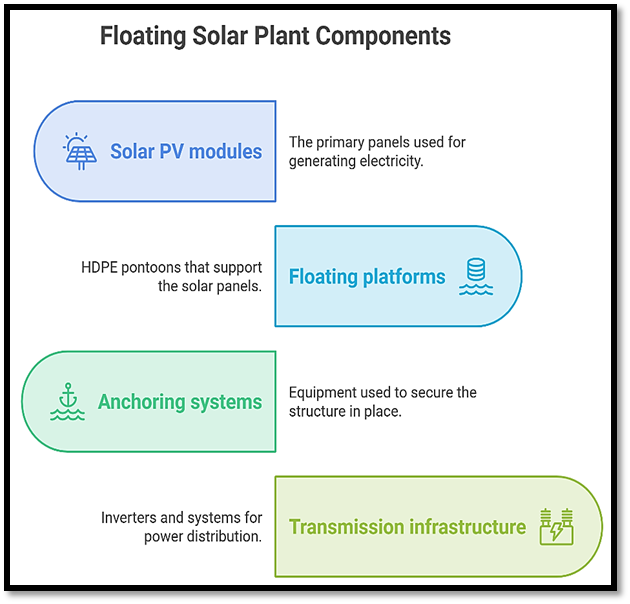
- Major Components
- Solar PV modules
- Floating platforms (HDPE pontoons)
- Anchoring and mooring systems
- Inverters and transmission infrastructure
Why is India Promoting Floating Solar?
1. Limited Availability of Land
- Avoids acquisition of agricultural and forest land.
- Reduces land-use conflicts and rehabilitation issues.
2. Better Efficiency
- Water cools the solar panels, improving their efficiency compared to ground-mounted systems.
3. Reduced Water Evaporation
- Solar panels partially cover the water surface, reducing evaporation losses from reservoirs.
4. Cleaner Energy Mix
- Supports India’s transition towards non-fossil fuel energy sources.
5. Existing Grid Connectivity
- Many reservoirs are located near hydropower stations, enabling easier grid integration.
Advantages of Floating Solar
- No requirement for large land parcels.
- Higher power generation due to natural cooling effect.
- Reduces algae growth by limiting sunlight penetration.
- Conserves freshwater by lowering evaporation.
- Complements hydropower generation in multipurpose reservoirs.
- Reduces transmission costs when integrated with existing power infrastructure.
Challenges
- Higher installation and maintenance costs than ground-mounted solar.
- Corrosion and biofouling due to continuous water exposure.
- Complex anchoring in fluctuating water levels.
- Environmental concerns regarding aquatic biodiversity if poorly designed.
- Limited domestic manufacturing ecosystem for floating platforms.
India’s Floating Solar Potential
- India has an estimated 278 GW floating solar potential across reservoirs.
- Omkareshwar Floating Solar Park (Madhya Pradesh) is India’s largest operational floating solar project and is planned to expand to around 600 MW.
- Several States including Madhya Pradesh, Kerala, Telangana, Andhra Pradesh, Tamil Nadu, Maharashtra, and West Bengal are actively developing floating solar projects.
Related Government Initiatives
- National Solar Mission (NSM) – Flagship programme for solar energy expansion.
- PM Surya Ghar: Muft Bijli Yojana – Rooftop solar promotion.
- PM-KUSUM Scheme – Solarisation of agriculture and decentralized renewable energy.
- Green Energy Corridor Project – Strengthening transmission for renewable energy integration.
| Important CTC from this article for UPSC: Pradhan Mantri Surya Sarovar Yojana Narmada River |
Q. With reference to Floating Solar Photovoltaic (FPV) Plants in India, consider the following statements:
1. Floating solar plants are installed on reservoirs, lakes, and other water bodies.
2. Floating solar panels generally operate at lower efficiency than ground-mounted solar plants due to continuous exposure to moisture.
3. Floating solar projects help reduce water evaporation from reservoirs.
Which of the statements given above is/are correct?
A. 1 and 2 only
B. 1 and 3 only
C. 2 and 3 only
D. 1, 2 and 3
Answer: B. 1 and 3 only
• Statement 1: Correct. Floating Solar Photovoltaic (FPV) plants are installed on reservoirs, lakes, ponds, dams, and other water bodies.
• Statement 2: Incorrect. Floating solar panels are generally more efficient than ground-mounted systems because the surrounding water cools the panels, improving their performance.
• Statement 3: Correct. Floating solar panels partially cover the water surface, thereby reducing evaporation losses, especially in water-scarce regions.