
Important for UPSC Prelims: History
Context
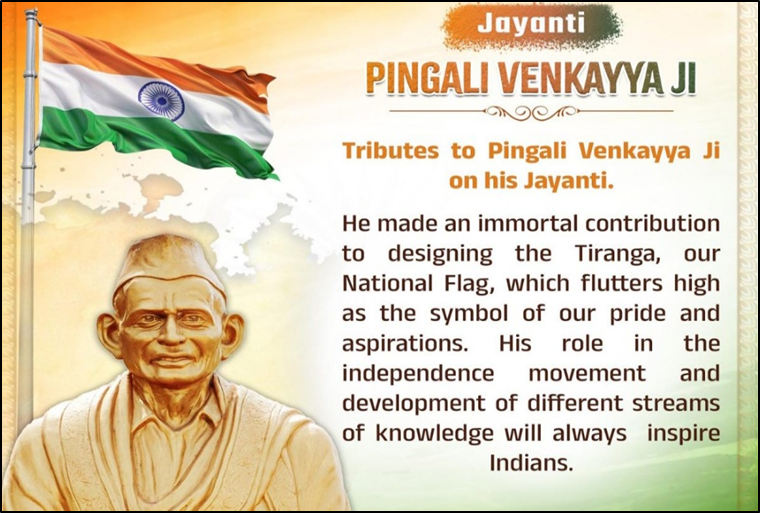
- The Prime Minister, Union Home Minister and Defence Minister paid tributes to Pingali Venkayya on his 150th birth anniversary, remembering his invaluable contribution as the designer of the Indian National Flag (Tiranga).
- He is also remembered for his contributions to India’s freedom struggle, agriculture and education.
Who was Pingali Venkayya?
- Pingali Venkayya (1876–1963) was an Indian freedom fighter, educationist, agriculturist and linguist.
- He is best known as the designer of the original Indian National Flag.
- He was born on 2 August 1876 at Bhatlapenumarru village, Krishna district (present-day Andhra Pradesh).
- He was popularly known as the “Jhanda Venkayya” for his work on the National Flag.
- He served in the British Indian Army during the Second Anglo-Boer War (1899–1902) in South Africa.
- He was associated with the Indian National Congress (INC) and actively participated in the freedom movement.
Contribution to the National Flag
- Pingali Venkayya designed the first version of the Indian National Flag, which was presented to Mahatma Gandhi during the All India Congress Committee (AICC) Session at Bezwada (now Vijayawada) in 1921.
- The original design consisted of red and green colours, representing India’s major communities.
- On Mahatma Gandhi’s suggestion, a white band and the Charkha (spinning wheel) were added to symbolize peace and self-reliance.
- The design subsequently evolved into the present Tricolour, adopted by the Constituent Assembly on 22 July 1947.
Evolution of the Indian National Flag
| Year | Development |
| 1906 | First unofficial National Flag hoisted at Calcutta. |
| 1907 | Madame Bhikaji Cama unfurled an Indian flag at Stuttgart, Germany. |
| 1921 | Pingali Venkayya presented the flag design to Mahatma Gandhi at Bezwada. |
| 1931 | Tricolour with Charkha adopted as the official flag of the Indian National Congress. |
| 22 July 1947 | Constituent Assembly adopted the present National Flag with the Ashoka Chakra replacing the Charkha. |
National Flag of India
- Adopted: 22 July 1947
- Designer: Based on the design of Pingali Venkayya
- Ratio: 3 : 2 (Length : Width)
Colours and Their Significance
- Saffron: Courage and sacrifice
- White: Peace, truth and purity
- Green: Faith, fertility and prosperity
Ashoka Chakra
- Colour: Navy Blue
- Number of Spokes: 24
- Adapted from the Lion Capital of Ashoka at Sarnath
- Represents Dharma (Righteousness), Justice and Continuous Progress
Flag Code of India, 2002
- Consolidates all laws, conventions and practices relating to the National Flag.
- Allows citizens to display the National Flag with dignity and respect.
- Amended in 2021 and 2022 to permit:
- Display of the National Flag day and night, if flown properly.
- Use of machine-made and polyester flags, in addition to hand-spun and handwoven flags.
Conclusion
The 150th birth anniversary of Pingali Venkayya is an occasion to remember his enduring contribution to India’s national identity.
| Important CTC from this article for UPSC Evolution of Indian National Flag & National Symbols |