
Important for UPSC Prelims: Environment | Health
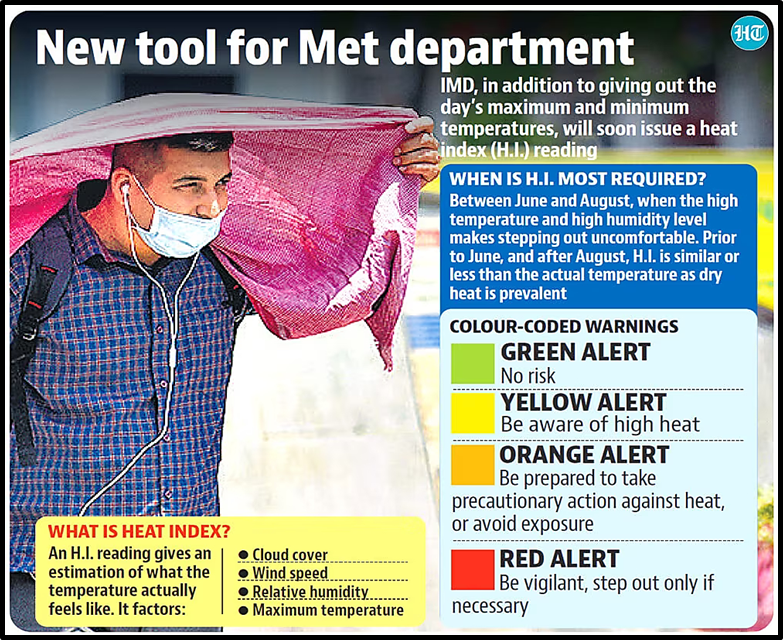
What is Heat Index?
- The Heat Index (HI), also known as Apparent Temperature or Feels Like Temperature, is a measure of how hot the weather feels to the human body after combining:
- Air Temperature, and
- Relative Humidity
- It provides a more realistic estimate of human heat stress than air temperature alone.
- Higher humidity reduces the evaporation of sweat, making the body feel much hotter than the actual air temperature.
Heat Index Risk Categories
| Heat Index | Risk Level | Likely Health Impact |
| 27–32°C (80–90°F) | Caution | Fatigue after prolonged exposure |
| 32–39°C (90–103°F) | Extreme Caution | Heat cramps and heat exhaustion possible |
| 39–51°C (103–124°F) | Danger | Heat exhaustion likely; heat stroke possible |
| Above 51°C (125°F) | Extreme Danger | Heat stroke highly likely |
Why Does Humidity Increase Heat Stress?
The human body maintains its temperature mainly through sweating.
- Sweat cools the body by evaporation.
- When humidity is high, evaporation slows because the air already contains more moisture.
- As a result, the body cannot lose heat efficiently, increasing the risk of heat-related illnesses.
Example:
- 38°C with low humidity may feel comfortable.
- 38°C with high humidity may feel like 45–50°C.
Factors Used in Calculating Heat Index
The Heat Index is primarily calculated using:
- Air temperature
- Relative humidity
The perceived heat may also be influenced by:
- Solar radiation (direct sunlight)
- Wind speed
- Clothing
- Physical activity
India Heat Index
The India Heat Index is a location-specific heat stress indicator developed by the India Meteorological Department (IMD), Ministry of Earth Sciences (MoES) for Indian climatic conditions.
It combines:
- Air temperature
- Relative humidity
- Solar radiation
- Wind speed
To estimate the actual heat stress experienced by people across different regions.
It helps authorities issue location-specific heat advisories, supports Heat Action Plans, and improves public preparedness during extreme heat events.
Conclusion
The Heat Index provides a more realistic measure of heat stress than temperature alone by accounting for humidity. It is an important tool for protecting public health and improving preparedness during extreme heat events.
| This concept has been discussed elaborately in the following article: Prolonged Heat Exposure During Pregnancy and Adverse Birth Outcomes |