
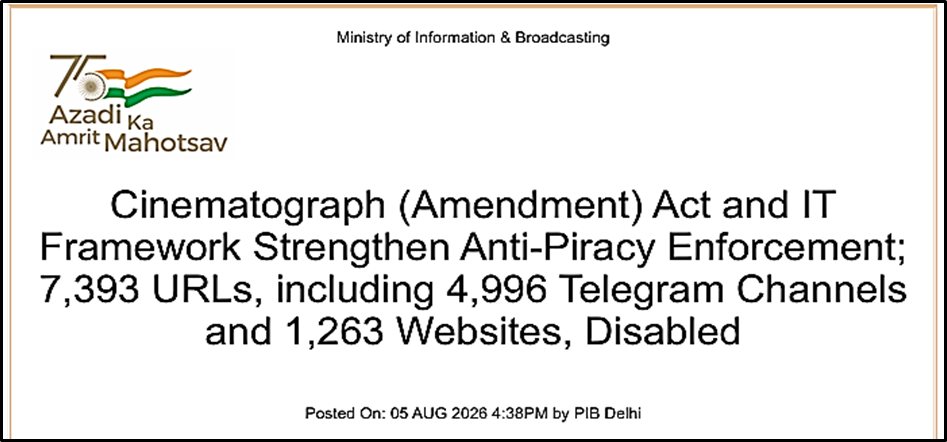
The Government has strengthened its legal framework to stop online film piracy, especially the illegal sharing of films through platforms like Telegram.
As part of this action, 7,393 URLs—including 4,996 Telegram channels and 1,263 websites—have been ordered to be disabled for hosting pirated films
Key Provisions
- Section 7(1B)(ii) of the Cinematograph Act, 1952 — empowers Government action against intermediaries hosting pirated film content.
- Section 79(3) of the IT Act, 2000 — basis for Government action against such intermediaries.
- Section 79(3)(b), IT Act, 2000 — enables appropriate Governments to notify intermediaries to remove/disable unlawful content.
- Information Technology Rules, 2021 — mandate intermediaries to remove content violative of law once notified via court order or authorized notice.
Institutional Mechanism
- Joint Secretary (Films), Ministry of Information & Broadcasting — authorized to issue content takedown notices to intermediaries.
- Takedown authority exercised under the IT Rules, 2021 and the Cinematograph Act, 1952.
- Institutional mechanism set up in the Ministry of I&B to receive piracy complaints from copyright holders and issue takedown notifications.
Enforcement Data
- 7,393 URLs disabled in total for film piracy.
- 1,263 websites disabled.
- 4,996 Telegram channels disabled.
- Disclosed by: Dr. L. Murugan, Minister of State for Information & Broadcasting and Parliamentary Affairs, in a written reply in the Lok Sabha.
Conclusion
The Cinematograph (Amendment) Act and the IT Rules, 2021 together form the legal backbone of India’s anti-piracy enforcement, under which intermediaries have been directed to disable 7,393 URLs, including 1,263 websites and 4,996 Telegram channels.
| Important CTC from this article for UPSC – Cinematograph (Amendment) Act, 2023 |